Author: rachael

Alex Bulmer: Leadership – The Virtue of Inefficiency

Alex Bulmer wearing black glasses looking upwards to the sky

Alex Bulmer joined the Sync Canada Ontario programme this June. An award-winning writer, director, actor and dramaturge and Artistic Director of Common Boots Theatre, co-founder of Cripping the Stage with British Council Toronto, and the Lead Curator of CoMotion 2022, an international Deaf and Disability Arts festival produced by Harbourfront Centre. Alex shares the spin and turn of her leadership metaphor and more besides.

A needle sat upon a vinyl record - it’s centre decorated with a fuscia pink and orange design.
‘A record album spins around…’
Audio of ”Alex Bulmer: Leadership – The Virtue of Inefficiency

A record album spins round and around as the needle lowers its tiny metal tooth into an imperceptible groove. Metal and vinyl: opposite elements, yet part of a collective whole.

This is my leadership metaphor – a vinyl album in motion delivering a series of artfully-arranged sounds.  On their own the sounds produced by single instruments hold energy (violin/electric guitar) yet somehow together they transcend expectation (orchestra/rock band).

The idea that effective leadership can actually go around in circles intrigues me.  According to the Oxford dictionary, “efficiency” can mean ability, coherence, labour saving, systematic, productive, effective. To me, the word suggests doing more with less, getting quickly from point A to point B, profit, machines….and even sight.

While swimming in a hotel pool in Los Angeles in 1997, I discovered the virtue of inefficiency.  I was on a solo trip from my home city of Toronto, or more accurately, I was giving myself “travel therapy” as an escape from the reality that I was “going blind”. On my first day in L.A. I asked the hotel staff for instructions to the outdoor pool, then used my cane to find it.

After several minutes tapping cement and patio furniture, I felt the end of hard and the beginning of liquid.   I knelt down, and reached with one hand to confirm that in fact I had found water.

Positioning myself at the edge, I lowered my body into the pool.

Once in it, I realized I had no idea of its size, shape, or depth. Reaching out, I felt the pool wall and traced it, swimming round and round for quite some time to comprehend its shape and size.

I discovered

cracks in the concrete

chunks missing, filters

and flaps

I noticed the “slap thwap” of water against the pool edge

it washed into a hollow sound by the ladder

and

a “slap echo thwap”

underneath

the diving board.

Slowly, gradually, through cycles of not knowing to knowing, I came to understand…

the pool shape —

was that

Of

a kidney bean

round at one end and narrow at the other.

I discovered the pool, gathering individual pieces, that, with sight, would have been eclipsed by the whole.

“Going blind” – two words which had, until that moment, suggested loss, a lack of awareness, a falling away.  But there, in that particular bean-shaped LA pool, this “going blind” felt like potential, a becoming – becoming one who circles, a collector of “what’s this”, a perceptual archaeologist.

And so, to circle back to my vinyl metaphor…

It continues to spin…

the metal needle remains connected,

moving along the groove.

Notes, rhythms, phrases, beats of time –

the unexpected, an emergence,

a work of art,

a song.

I am my metaphor. Blindness is a kind of time zone. Perceptual archeology nourishes a sense of meaning and connection. With this, I – and others should thrive. But we live in a “one size fits one” society, designed to streamline most of what we do, to make us “efficient”.

We need to build more liveable futures imagined and designed to enable rather than disable. Being enabled, or having access needs met, should not be a privilege held by some. It must be a shared public value, along with clean water, public health care, electricity and roads.

Imagine a Canada wide access grant to cover personal support workers, interpreters, adaptive technology, direct funding available to those who experience barriers or are at risk of exclusion.

Such a thing exists in other countries. Imagine shifting the politics of “help” toward transactional rather than charitable.

Imagine beyond the assumed….

Sean Lee – coaching curation

Portrait en buste d’une personne portant une chemise aux couleurs vives et des lunettes

Sean Lee joined the first online Sync cohort in Ontario in May.  They share their experiences of the programme and how they are exploring the qualities and constructs of coaching to impact and empower curators and artists to find their own solutions.  Coaching is an essential part of the Sync programme where participants receive professional 1:1 coaching as part of the programme and learn how to coach as part of their leadership, moving forward.

 A collage made in a Sync Canada session. Logo’s and slogans are cut out from household items, arranged in a collage on a pink hued rug.

This year, I took part in the 2020 Sync Canada Leadership program – a disabled-led program exploring Deaf and disabled leadership with Sarah Pickthall and Jo Verrent. Sync was the kind of disability-led program that I felt had been desperately missing during my academic training and I felt it was of vital importance to my own career trajectory to be able to expense mentorship from other disabled arts leaders.

Of course, it was also during this time that the COVID-19 pandemic made it impossible for our cohort to meet in person, and thus we moved to an online platform. My online experience with Sync and the ways the arts ecology has shifted to online, have played a big part in developing and strengthening my perception of the importance of intimacy.

In particular, I continue to come back to the idea of access intimacy as provided by Mia Mingus — as that ‘elusive, hard-to-describe feeling when someone else ‘gets’ your access needs’ — and how this concept might help us understand the nuanced factions of togetherness in a community that has historically been in isolation.

Sync’s shift to online meant the ways a program was accessible suddenly shifted, and they admirably modified the program in a way that allowed our cohort to come together meaningfully in a time when isolation was the norm.

It’s with this frame of mind that I found the Sync Leadership program has helped me to continue exploring how I might think of the intersections of Disability Art and accessible curatorial practices. These ideas are inextricably linked, but one does not imply the other; for example, a disabled artist may not be considering other avenues of access within their work or an accessible exhibition may not include any disabled artist representation.

To realize both is not as straightforward as one might assume. In many ways, when approaching accessible curation as a framework, it may be enriched through coaching, as a way of drawing out the political potential of an artwork rather.

Accessible curation and coaching both involve letting go of the world as we currently know it, and aim to draw out the potential of its engaged party. When I think of accessible curatorial practice – a concept that I believe must come from those with lived experience of disability – I believe the choices we engage are in many ways world building and dismantling.

Rather than adapting disability to fit art, when engaging accessible curation, it is art that has to fit disability. In doing so, engaging disability arts creates a sensation of the political possibilities that nod to new frameworks of gathering and creating community.

But in order to reach this potential, it is the artistic choices of the artists that ultimately drive our movement forwards. It’s here that I feel the ideas of coaching, as applied to frameworks of creative access, can tap into the political potential of disabled artists in ways that allow us to express a sense of interdependence in our worldly arrangements.

In the Sync Leadership program, our cohort of disability artists, curators and arts leaders were given a number of coaching tools that we could apply towards our own practice and I found the idea of a Coaching Cycle formalized many of the ideas that I feel I already practiced in working with artists. The cycle included:

  1. Equality
  2. Letting Go Of Your Map Of The World
  3. Absolute Attention
  4. Curiosity
  5. Open Questions+
  6. Light Bulb Moments

As a curator employing accessible curation, the Coaching Cycle clarifies a structure of working with new and emerging disability artists who are hoping to engage creative access or go beyond “standards of accessibility” in their work.

I feel that many of these elements in the coaching cycle embody a framework of access intimacy, and are about creating trust between the coach and the coachee – a similar dynamic to the curator/artist relationship that I am working towards establishing.

For me, the Sync Leadership program was about instilling in myself a sense of structure in my work – that the underpinning element of successful arts leadership is to allow our passion and identity to drive our purpose. In doing so, our choices would create the gateways towards true access intimacy.

Are you living and working in Quebec, apply to Syncleadership.com for our new online 5 day intensive 19th – 23rd October 2020. Applications close on the 29th September.

Perceptual Spaces: Sarah Pickthall

A hand holds a glass sphere with a tree seen through it.
Photograph by Mark Pickthall

Volatility

We are living through daily uncertainty, awash with challenges and the best and worst of our behaviours as human beings. Yet volatility gives rise to possibility. So how do we harness the heat of these uncertain times? Coaching is one way to tap into disturbance and disquiet within ourselves, seeing, feeling and reflecting on the possibilities, that changing our tack might bring. Meg Wheatley has more to say about the power of reflection and paradox questions here. 

Coaching and Bias

Coaching is a space for us to take time to think and reflect in relationship with another. Through absolute attention and questioning from the coach, the coachee is able shape new possibilities, challenging the default patterns that may not be serving them well.

Between stimulus and response there is a space. In that space is our power to choose our response. In our response lies growth and freedom 

Hetty Einzig

So what are these patterns? We know as human beings we are very quick to react and that responding quickly to what happens is a natural part of how we defend ourselves at times of threat – but it’s not always a good strategy.

These well-trodden paths can also be about our beliefs and assumptions, ‘perceptual snapshots’ as Deepak Chopra calls them, and may be biased.

Bias is something we all have. To say that we are unbiased would be untrue, because bias is built from when we are young and not in control of how our life is shaping around us. As a result, however much we think that we don’t judge or discriminate, this simply isn’t the case. We may be negatively biased about what we ourselves feel we can, and cannot do, as Deaf and disabled people. We need to deal with this, but how?

Study and Practice

Every time our awareness is raised about the bias we have or the privilege we hold is an opportunity. These things are nothing but a mark in sand unless we look in the face of our bias and change our behaviours; to completely reshape the beach beyond the ebb and flow of tides.

To do this we need to take time to study and reflect upon the history informing our present lives; to see clearly the bias we hold and then be the change at every turn, asking ourselves – who is not in the room and whose voice is not being heard?

We can do this when we gather together and work things through in collective inquiry in a way that welds together our diverse lived experiences and differences of opinion.

Renewal and the New

At the still point of the turning world…..there the dance is.

 T S Elliot

Many of those who have joined us on the Sync programme have benefited from Sync’s blend of leadership, coaching and collective working for what it has revealed.

For instance, Sofya Gollan from Australia shed her skin through Sync, saying no to the discrimination she faced as a deaf woman in film and yes to different routes into getting to the position of power she now holds. And Won Young Kim from Seoul, who said ‘why not?’ to combining his legal career with a dance and theatre practice, reshaping ideas of kindness, beauty and form in South Korea.

Sync is dedicated to tapping into the leadership possibilities for Deaf and disabled people in arts, culture and beyond, unleashing this untapped potential for change.

Sally Booth

Sarah Pickthall meets Sally Booth

In the first month of the COVID-19 contagion, I dropped visual artist and Sync alumni, Sally Booth, an email to see where she was up to in isolation and whether she would be up for a catch-up on all things cancelled and on what it’s like pressing the re-start button on her career.

Sally wrote an article about her practice for our Sync programme back in 2010.  A decade on from the Sync Leadership programme in 2010, Sally has gone from strength-to-strength and has been in regular employment as an artist and facilitator, returning to the UK just a few days before lockdown from a successful cultural exchange in Chicago with Shape Arts.

drawing of chicago skyline
Chicago Skyline, drawing by Sally Booth, March 2020

From Edges and Extremes across Shetland and Cornwall with showcases and performances at the Turbine Hall, Tate Modern, to sketch-booking on the London tube, her portfolio career has combined commissions and training around the social model of disability.  As a regular trainer for VocalEyes, Sally explores and shares the depth of her experience of visual impairment, bringing art and culture alive through audio description.

Speaking together in the fourth week of lockdown in England, Sally shared that the solitude was lovely to start with and very familiar to her as an artist, but after a few days, the impact of losing all foreseeable work and the impending isolation ‘hit home hard.’  My email to reconnect led Sally to address the digital gaps in her day-to-day routine. Whilst her website won a Jodi Award for Accessibility in 2009, her lack of access to social media, and more importantly digital meet-ups and hangouts, so relied upon by us all, was painfully thin.

a woman is holding an ipad in her garden whilst a neighbour and small child calls out instruction from over the fence
Sally works out Zoom on her iPad with her neighbours

In preparation for our Sync Zoom interview, with the help of the neighbours, Sally managed to download Zoom and Otter.ai apps onto on her iPad, creating captions and audio of our conversations. This will help with captioning the short film we made and she will continue to use this tech, despite its limitations. Sally has even been doing audio descriptions of her pictures over the fence.

a small girl plays a game with an adult on a table
Sally and her father playing ‘Pick-up Sticks.’

Together we were able to have a joyful conversation, exploring a new leadership metaphor that explains very clearly the experience of having to start-over a childhood game she played with her father, called ‘Pick-up Sticks’.  We also spoke of intimacy; that we will both miss the nuances of working closely with people, be that in training, coaching or at a gallery. We both remarked that despite this, we had in our virtual reminiscing together rekindled our lovely rapport and laughed our socks off.  You can watch the video of our conversation with an Audio description introduction for the film underneath.

A film of Sally Booth talking with Sarah Pickthall about leadership metaphors
Audio Description of Sally and Sarah’s Zoom conversation

Won Young Kim

When Won Young Kim took part in Sync Korea, he was exploring a dilemma: that of needing to continue to practice law to meet the responsibility of supporting his family – but with his heart very much taken up with developing his artistic practice. Since that time, using a simple metaphor, he has managed to blend both ambitions, honouring both his values and his desire to make great artwork and challenge ideas and thinking around aesthetics in South Korea and beyond.

shows a man performing on a shining floor seen from above
Won Young in an improvised film performance, Seoul, 2019

Sarah Pickthall talks with Won Young Kim

Meeting online in May, Won and I spoke of the impact of Covid in our respective cities, me in Brighton and Won in Seoul. This hadn’t been the first time we had met up together since running Sync in Korea in 2018, the last time being to work on a profile of Disability Arts in South Korea for Disability Arts International in 2018.

Won shared that there had been a lot of disabled activists challenging the government and some successful and significant movement in moving people out of institutions during the pandemic, ensuring disabled people had the right to be treated in hospitals alongside everyone else. This had felt like a huge achievement and a step forward politically in South Korea.

shows a man speaking into a mic and holding out his hand as he gestures
Won Young Kim

Law has been part of Won’s life for many years, but there has always been the underlying compulsion to make artwork, be that theatre, dance or live art. At the time of Sync in 2018, Won reminded me that I had just simply asked him one question: why? Why wasn’t he able to do both? What was stopping him? This simple question was the start of him finding a way to bring both interests into play, culminating in some acclaimed performances in Seoul in 2019.

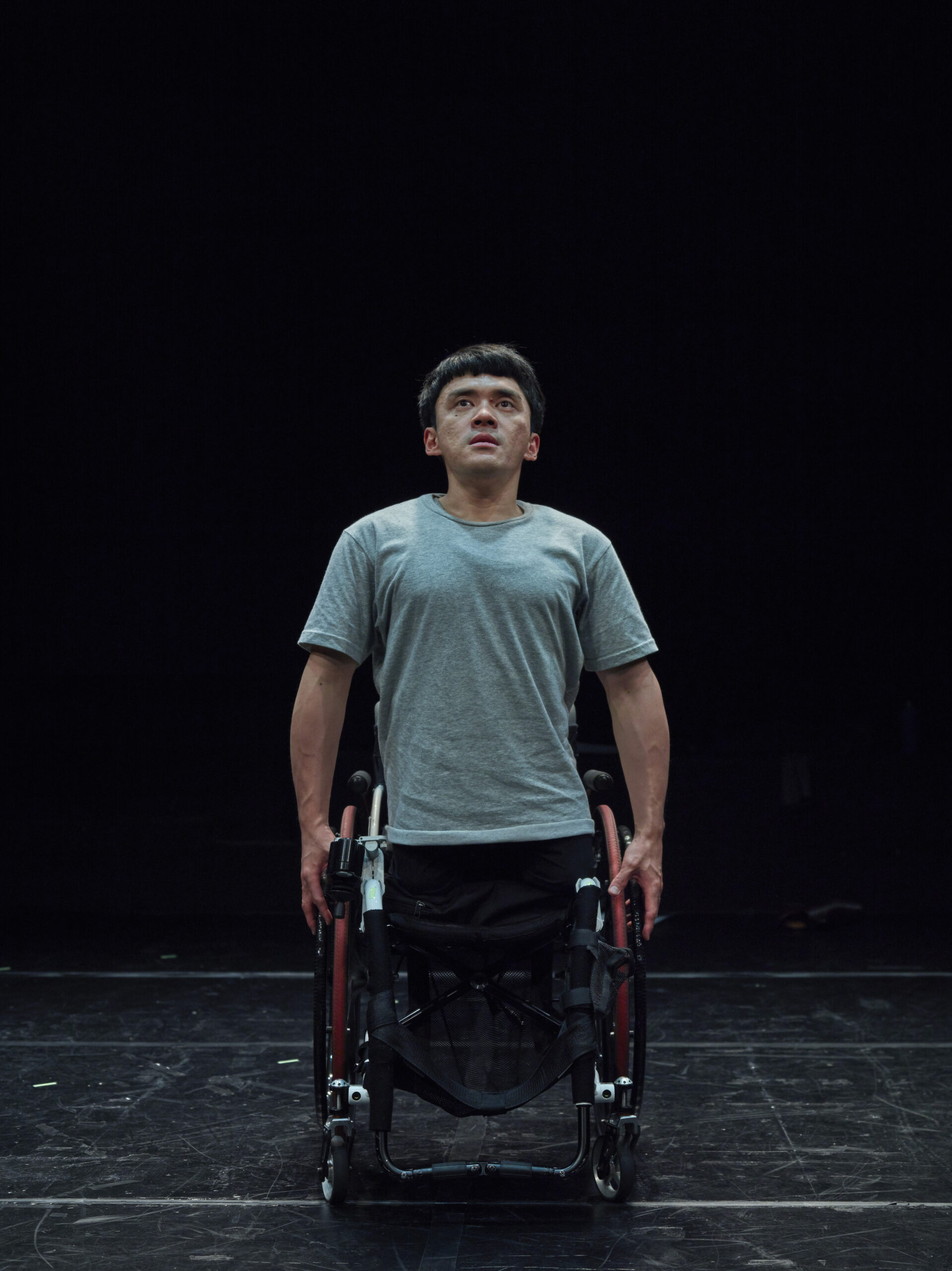
“The artworks described a piece of fictitious law – ‘An Act of Love and Friendship,’” he told me, and as part of this performance he told the audience about this law. Alongside this, Won made a significant step to get out of his chair, something he had never done in public before. “I was worried at the time, that audiences would see me doing this as ‘a freak show.”

On the contrary the work was felt by many to be visceral and powerful but not in a patronising way. The ‘move’ was received well with people quite active across popular mainstream culture, lauding it and his work being nominated for an award.

Won went on to talk of the ‘big trousers’ that he has over many years worn, to assume a so-called ‘normal form.’ It seemed this was important for him to appear a certain way when out in the world from a very early age and through his legal career.  An artistic colleague and friend drew his attention to the performance work of UK dance artist and performer, David Toole, someone who has used his physicality in bold and exciting ways in a career that has not shied away from the public gaze.

shows two men in a dramatic scene, one in front of the other, one in a wheelchair, the other standing behind.
Won Young Kim performing in Love and Friendship Act by Zero(0)set Project, Seoul, 2019

Won can now more easily see himself pursuing his performance work, with plans temporarily on hold, to do workshops with choreographer Adam Benjamin when restrictions are lifted and international travel is possible again.  This fed into our conversation about the Sync metaphor he chose during the course in Seoul in 2018, which I had remembered as ‘The Game of Go.’  Won reminded me that it wasn’t the game itself but the simple ‘ordinary’ stone that was the metaphor.  

As disabled people, when we are in the confines of our own spaces, away from the gaze of others, getting out of a chair or moving in a way that suits us isn’t something we necessarily think about. However, how we reveal ourselves in public can be a very different matter, as we bid to conform with what society deems acceptable.   

This has now extended into how we show up in virtual spaces too, and the potential is there for us all to be a bit more flexible and relaxed in this respect. Here’s an article on the Softer Edges of Online-ness.

Dolly Sen

In late April, writes Sarah Pickthall, I had the chance to tap into the brilliant mind of Dolly Sen to see where her Sync thinking was, in this, the time of COVID-19. I found Dolly to still be the subverter, albeit softer, calmer, more contained and in isolation by the sea, waiting for the right moment

shows a portrait photo of a woman looking at the camera, her arms folded in front of her.
Dolly Sen by the sea in 2020

In a bid to draw together contemporary disabled and Deaf Sync alumni leadership perspectives for a refresh of Sync Leadership online in May 2020, Dolly Sen was an obvious choice.

Having interviewed Dolly several years ago when she was part of Sync Leadership in the UK, I was curious to see how this artist, activist and curator, performer and filmmaker was using subversion to chart her particular approach to life and her practice. I wanted to know what, if anything, had shifted and changed in how she was making work and fighting for what is right.

She has certainly focused more exclusively on her art practice more recently curating a group show at Bethlem Gallery.

Our conversation started with a fond reference to Homer Simpson, an underrated philosopher in her mind, who, taking his daughter Lisa’s reference to the word crisis, in Chinese characters blending ‘danger-opportunity’ (危機) coined the indelible phrase, ‘Crisistunity’. The current pandemic challenge is potentially brutal and yet provides a very clear crisistunity for Dolly. “People at last are seeing and experiencing the cannibalised health and social care system, the decimation of benefits,” she shared.

The need to strike whilst this particular iron of COVID-19 is hot feels pressing. “I can reach more people, who have seen it with their own eyes, not just in the abstract. Normal is what was wrong in the first place. I am beginning to see how I can use this really harsh time to change things for the better.”

shows a smiling woman in a white medical coat holding a yellow colored card in her left hand
Dolly at the Wellcome Collection, 2020

She reminded me that she’s never had a particular strategy or approach, rather using the power of intention and waiting for the right time for her ideas to emerge.

Submerged as we are in a glut of resilience noise online, posting across social media is where we see her ideas and artwork more consistently now compared with when we first met. 

Since the start of the pandemic, she’s been releasing light-hearted useless hints and tips for lockdown to this effect. “If you laugh at something, it loses it’s dark power.” Her output is hosted in a blog on the long-established Disability Arts Online website.

“If you laugh at something, it loses it’s dark power.”

Dolly Sen

The arrival of Scamp the family dog has additionally provided a great way to connect differently with new audiences. We’ve always loved Dolly for her enduring love of all things sheep in her work and everyday; but upping her social media output with Scamp in tow, she has been approached by people using him as a conversation starter and first step to securing major commissions, though some of these, like many things, are now on hold. 

Dolly shared that she was feeling surprisingly calm and grounded in the face of the enormity of COVID-19 and the inevitable loss we are experiencing, and yet to experience. We spoke about how this may be informed by a life of surviving serious discrimination and changing mental health. Had that experience possibly made her more realistic, and grounded, in the face of extreme events?

A picture of a red plastic charity tin saying 'Help the Normals' and 2 boxes of Dignity pills that say "Dignity cannot be taken 4 times a day" The credit in the photo says Dolly' Sen's '"Dignity" is shown (Courtesy of the Wellcome Collection).
Dolly Sen’s “Dignity” features a prescription pill box that proclaims “Dignity cannot be taken 4 times a day”. (Image courtesy of the Wellcome Collection)

For me, as co-creator of Sync, this illustrates how important our lived experiences of resilience in the light of disaster are. It also shines a light on the need for leadership as we emerge from the pandemic as a society and this is what these Sync think-pieces will tap into. For many of us, a lifetime of restrictive and radical events has required us to be grounded in the face of adversity. The question we have now is how best to place and position the strength of disabled leadership, whilst so many of us will be in lock down for longer.

Sofya Gollan: The art of saying ‘yes’

Sofya Gollan had so many credits and achievements to her name when she joined the Sync Aus programme in 2015; yet she felt she had hit a place and time in her life where she wasn’t progressing. Even if we have credits and accreditations, the subtle and not so subtle barriers in society continue to discriminate against our Deaf and disabled professional progression – and stop us in our tracks.

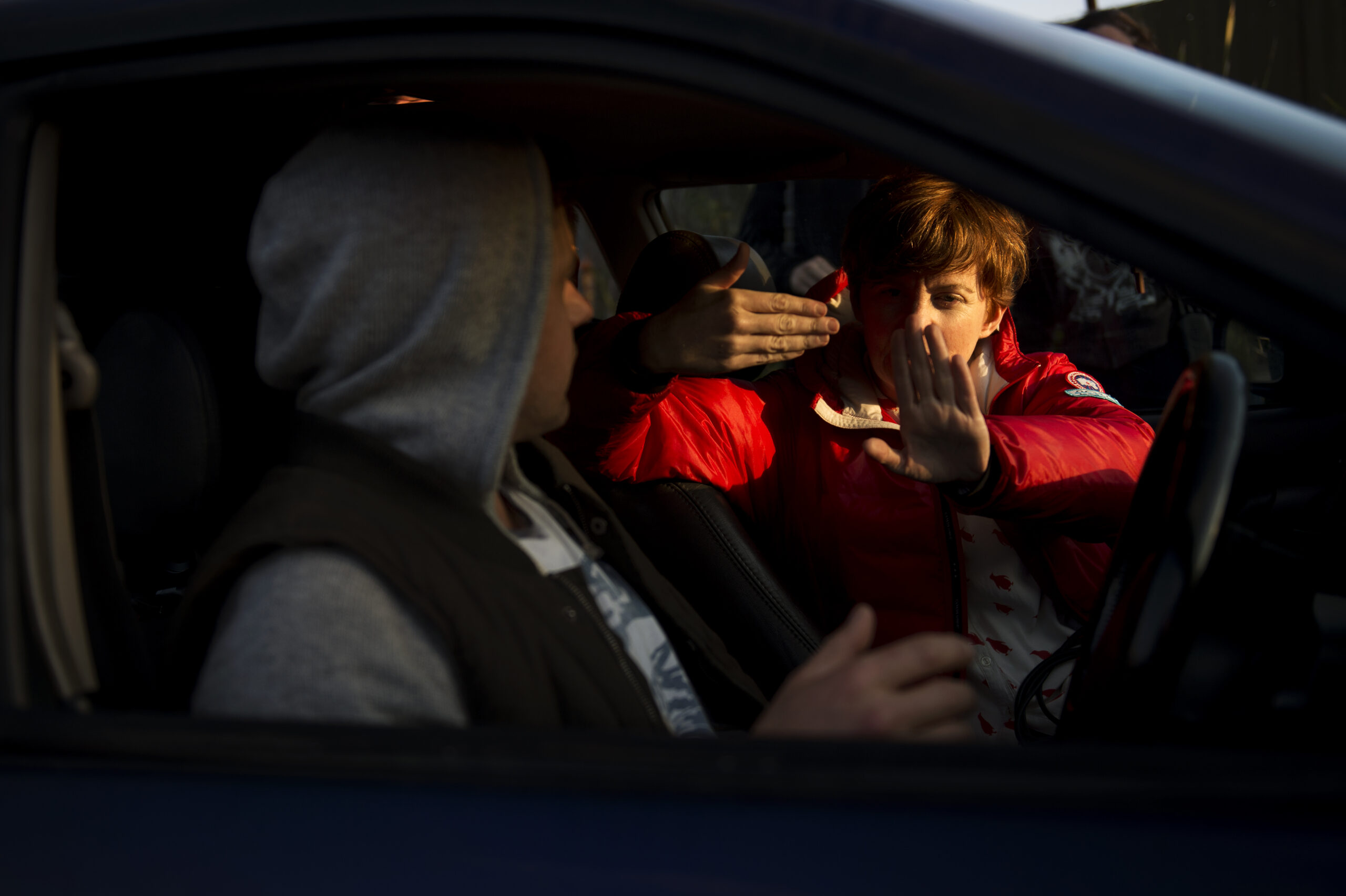
Sofya in a bright red jacket in the passenger seat of a car, giving direction to an actor in a hoodie behind the wheel.
Sofya Gollan – on set, directing her short film, Gimpsey (2016)

Sarah Pickthall talks with Sofya Gollan

I met with Sofya online in May to discuss the impact of Sync way back then in helping her shed her skin and think again. She is now holding a position of authority as Screen Investment Manager at Screen NSW. Sofya and I share a history of sorts – our involvement in inclusive television. For myself, this meant working for 10 years as part of the Art Attack Team in the UK with their ‘sister’ project ZZZap, which was designed to include deaf children along with mainstream programming for children in the UK. I wrote scripts for the show and my hands, now retired, were The Handymen. Sofya, quite early in her career, joined the presenter team at Play School in Australia and has been involved in the programme for over 30 years alongside a career in media.

Sofya on an orange sofa, presenting live on Play School, for ABC, Australia
Sofya Gollan presenting on Play School, for ABC, Australia

An award-winning director and writer of documentary and drama films, Sofya’s films have been screened in major international festivals over the decade. One of her most recent short films, GIMPSEY, which she wrote and directed, was nominated for an ACCTA Award in 2017 in the Social Shorts and is featured at the beginning of the film we made when we spoke together on Zoom.  

Loving a leadership metaphor, and that being a part of what we explore in a Sync programme, I asked her to recall the one she chose all those years ago. She was unable to recall it, which in itself was quite funny.  Yet choosing a leadership metaphor doesn’t mean you have to stick with it. 

A fluorescent green snake shedding the skin from it's head.

In fact we can choose different metaphors and analogies that reflect where we are at any one time in our professional careers. Our conversation continued with a focus on Sync being something that allowed her to shed her skin like a snake. 

Watch the video of our conversation – including short clips of Sofya’s film Chlorine Dreams (1998, 10mins.) A young girl finds a ghost-like boy living in her pool.

Sofya and Sarah talk over Zoom, May 2020
Audio Description of the Zoom conversation between Sofya Gollan and Sarah Pickthall

It’s not just the deafness but the intersectional experience of gender identity and being a person with a disability, she explained. The industry is still so biased in so many ways.  The blend of being deaf and a woman was hitting hard at the time, so how did Sync help? ‘Well, I think it was in our coaching that we explored the idea of saying yes to everything.’  I remembered the coaching conversation we’d had at the time. 

Sometimes adopting a different strategy for a while can bring an unforeseen opportunity. Putting herself ‘out there’ was not new to Sofya but in the face of rejection and doors slamming, choosing this with a lighter, less defeated strategy, of saying ‘yes, why not?,’ felt different. With Sofya well known to audiences in Australia, she already had the natural ability to put herself out there, but driving this in a different way. 

Shedding the skin of old tactics and bringing in the new paid off.  The first opportunity she said yes to, ‘can be directly attributed to getting me to where I am now’ she shared. It was that simple.  

In her role now, investing in other people, she is responsible for the end-to-end management of screen content that ranges from international co-productions to stand-alone short films. Not only that, as a creative, she still holds a passion for narrative development in VR and is making her own work shedding the skin of other people’s thinking with a focus on new lived experiences in compelling story lines. 

Sync allows you to rethink things, gives you the time, the space and the attention to refresh yourself and renew. So why not you? Whether you are part of Sync now or are thinking of applying to be so, our plans are to share insights and activity in the weeks and months ahead. That’ll be about taking a different tack, shedding your own skin, breaking through and seeing what emerges in these very taxing times.