Category: Leadership thinking

Acting without Permission – Sarah Pickthall

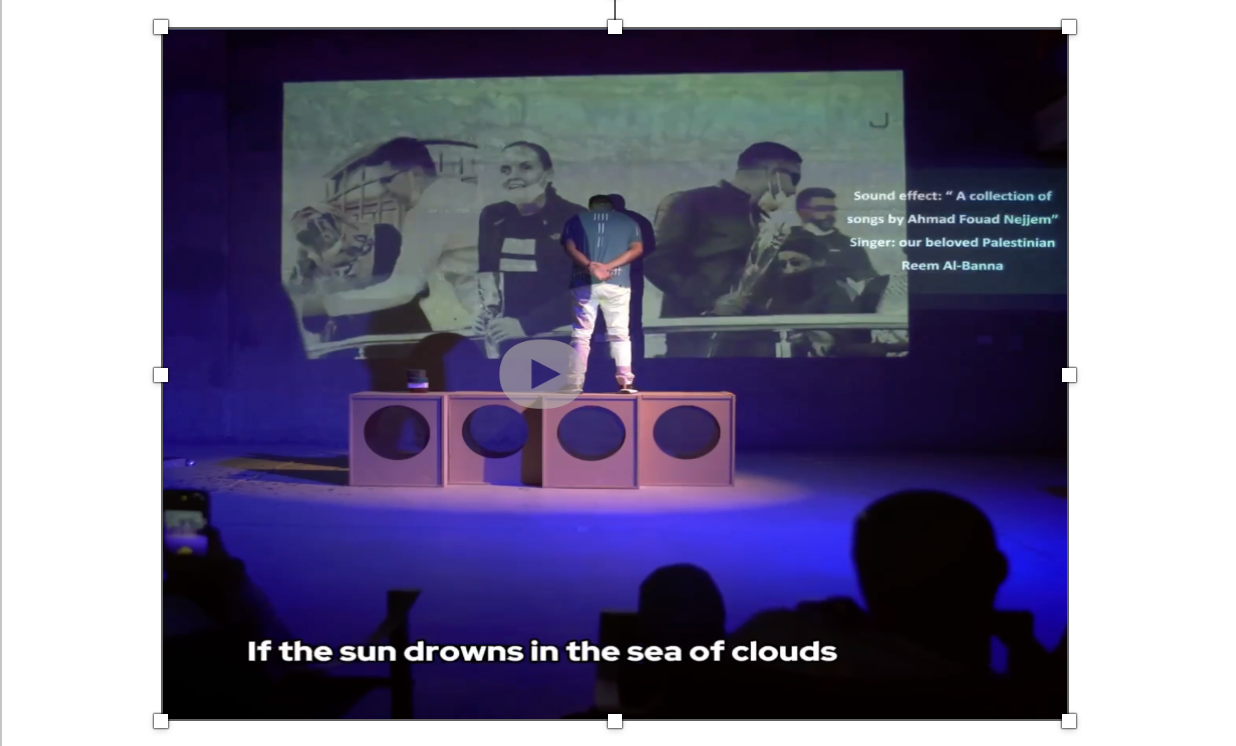
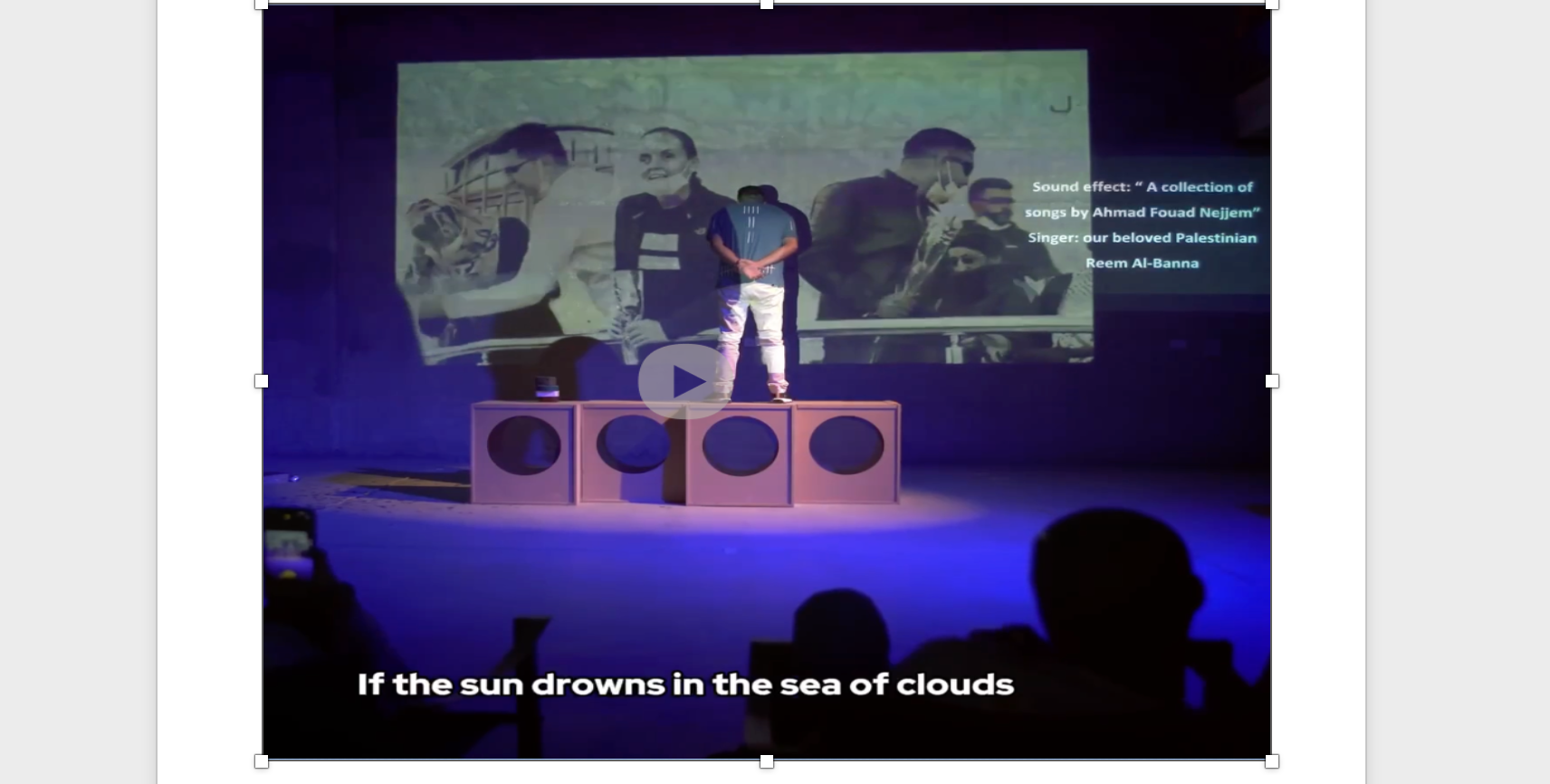
ID: Hamad Samamrah performs in the show, he stands upon boxes, film footage of his fellow protesters as they receive a positive outcome at the end of their Sit-in, the words read If the Sun drowns in a sea of clouds. Sound effect: A collection of songs by Ahmed Fouad Nejjem. Singer: our beloved Palestinian Reem Al-Banna

Last week was a strange one, full of disappointment for self and others but also a week that surfaced a new sense of what disabled-led steadfastness and stealth can feel like in the fight for disability justice in all its manifestations in our respective societies today. Disappointment yes, but source of joy and impetus in so many ways.

The chance for Sync Leadership to join hearts and minds again with Shubbak Festival was compelling. We came on board to share the story of 63 Days of Sit-In – a performance and documentary film by Basta Theatre Collective based in Palestine. The showcase was at Theatro Technis in London, and it felt such an apt and a vital continuation of the work started with British Council investment in Sync Arabi through our leadership programme in partnership with ArttoHeart in person in 2023 in Jordan and the UK.

Deaf, disabled and neurodivergent leadership and community building often have activism as a core construct. It is all too familiar to be left with no choice but to take to socials and the streets to protest at the inequity of life and opportunity, over access to health insurance and care, travel and transport, buildings, education – arts and culture, access – all of it.  We are left out of so many decisions about our lives and leadership, it feels unfathomable at times. As one of the Palestinian ‘fighters’ in the documentary so poignantly shared, if we are included in our society, ‘we complete each other’.

Sync worked alongside Willie Elliott. 16 years ago this month, Willie was a key protagonist in the audio description at the opening of the London 2012 Paralympic Games – an unforgettable spectacle which Jenny Sealey (a Sync Alum) co-directed. It still stands as a testament to the energy and joy felt in the fusion of arts, access and activism! Telling our stories often feels like activism or acting up in some way and there’s power and celebration in that. And laughter too – where would we be without that?

Willie also shaped the live AD for 63 Days of Sit-in, both its performance and the documentary film.  I mentioned disappointment in my opening sentence: when the lead actor, Hamad Samamrah, became ill during rehearsals last week in London and was unable to perform, the impact was felt deeply by us all. 

Despite this the audiences still joined us and were able to connect with this powerful piece of activism through a touch tour of the set and an accessible film screening. It left us feeling closer to Hamad, even in his absence, and to his life’s work, and to the fellow disability rights activists who protested inside the Palestinian Legislative Council during the COVID-19 pandemic. We also bore witness to the incredible allyship of Hussam Ghosheh and Basta Theatre has brought to this important protest in history. We were lucky that Hamad could at least join us for the Saturday Q&A, and it’s fair to say that our lives were changed by his story and contribution and those of his co-conspirators.

It is crucial to tell our stories, and these stories emerging from the region and in Gaza – areas of exponential disablement – are more profound than we ever thought possible. As disabled people we must not shy from talking about what is happening, acting without permission to get these voices heard.

Another story perhaps more widely known is the soon to be screened Being Heumann – a film focusing on the better known life of Judith Heumann whose activism paved the way for others often described as of the ‘Mother’ of the Disability Rights Movement in the US’. The film is to be premiered at the Toronto Film Festival (10th Sept) and it features other Sync alum and associates, namely Alex Bulmer (our Sync Leadership co-facilitator) and Yousef Kadoura, who supported our Sync podcasts and promotional films in Canadian projects over several years. Our very own Ruth Madeley takes the title role as Judy, a UK export on the back of her portrayal of the brilliant Barbara Lisicki in the BBC, 2022 drama ‘When Barbara met Alan’.

But back to our Sit-In week. Alia Alzougbi CEO and Artistic Director @Shubbak in rounding up the Q&A on Friday, spurred us on with 3 crucial pieces of advice: occupy, don’t ask for permission, laugh a lot. Sublime advice for all of us! Let’s find the laughter in amongst the disappointment and challenge, and experience the empowerment solidarity brings.

63 Days of Sit-In was developed with the support of the Disability Under Siege (DUS) Network, University of Birmingham and British Council Palestine through the Jerusalem Creative Spaces programme with the London presentation supported by British Council, Wijhat (an initiative of Al Mawred Al Thaqafy – Culture Resource), SyncLeadership and Dais Hale.
Reflections from Connection – Kristina McMullin

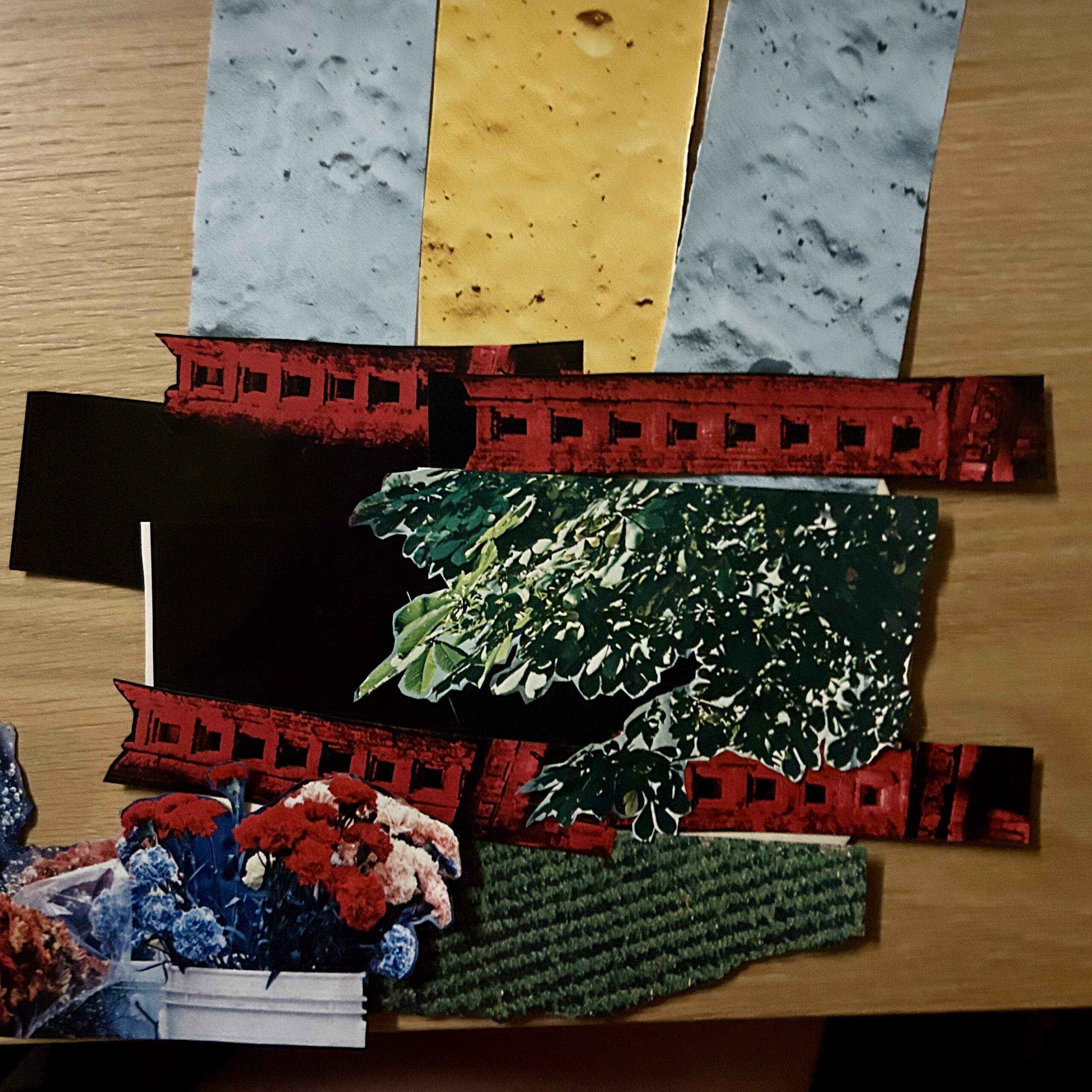
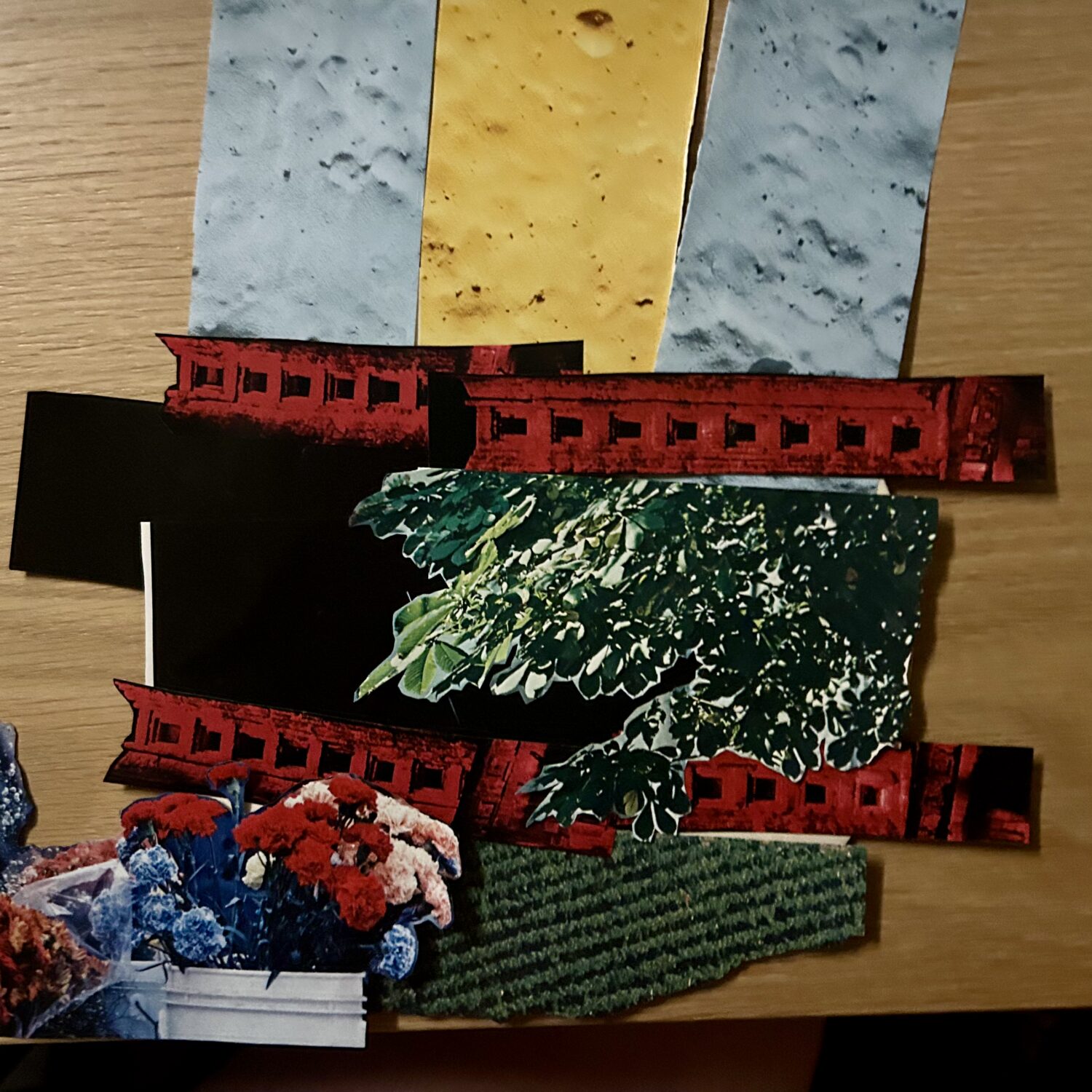
work in progress collage

Work in progress mixed media collage

Kristina McMullin, 2026

When Sarah invited me to join the Sync team a few months ago, I was thrilled!! I participated in Sync in June of 2020. A time, for many of us, myself included, defined by disruption and isolation. The five day intensive was like a buoy in a vast ocean, the cohort that gathered quickly became a safe, nourishing, and encouraging community. The five days, and the lessons I gained from them, guided the next chapter of my professional and personal life.  

Two years later, I joined Sync Twilight as an action learning coach. While I had spent much of the past two years putting into practice what I had learnt during Sync, Twilight coincided with a turbulent season of my life, again the program and the community became a buoy. I had assumed serving as a coach for Twilight would not return the same community I had prior, but, of course, I was wrong. The small group I was in became a tight knit community almost instantly, after a few sessions, we were all sharing things with one another we wouldn’t normally share. That safety emboldened us to take bold next steps in our professional journeys. 

Now, in summer 2026, we are not in the early days of a pandemic, and my home and personal life is devoid of chaos and turbulence, and Sync has found me again. The gift of this position is perspective and curiosity. I have been able to look back at who I was and where I was and how the lessons of Sync have changed me. With this perspective, my curiosity turned outward to the rest of the Sync community. 

When in people’s lives did Sync find them? 

How did Sync integrate with and influence their lives? 

What lessons and learnings have they brought with them?

What more can be done in service? 

How can I learn and grow from this wisdom? 

I have had the opportunity and privilege to speak with a few alumni of Sync, some who I know well, some I’ve crossed paths with, and those who I met for the first time on our zoom call, all who brought a level of generosity to our conversation that has been both a gift and teacher. 

Sync has a funny way of finding people in very specific times in their lives, whether that is while completing a different residency, while busy and not in the best place, and while delving deeper into an arts practice. Wherever one may be, Sync will meet you there, and how you arrive will be welcomed, desired, whole, and enough. 

When it came time to delve into what folks had learned about themselves through Sync, 

Laura, an alumni of Sync Atlantic, called her leadership style symbiotic and patient while Louie, an alumni of Sync Alberta, called theirs bravely authentic, Seeley called hir leadership style adaptable, creative, curious, passionate, patient; naming that Sync’s process allowed hir to look inward to name these traits. 

What these three leadership styles signal, is a generosity to self and community. Community and generosity are central to Disabled leadership, how those materialize in each of us, is a unique art form. 

For each of them, Sync has offered both a community and proof that strong Crip communities can be formed when we centre honesty, intentionality, and accessibility. We carry our communities and the truths we know into our work, our relationships, our futures. 

Like my first introduction to Sync in June 2020, these conversations have been transformational for me. An offering to look inward to guide my path forward. 

Through every conversation I’ve had, a few things remain steadfast: Disabled folks know, intrinsically, how to build and maintain community, Disabled leadership is as multifaceted as our community is, there is purpose and meaning to the things that come into our lives, true magic occurs when we are supported wholly.  

In 2020, my leadership metaphor was a microscope able to zoom in or zoom out, but hazy in the in-between. Six years later, I’m no longer looking for a crisp image, faulting myself for not finding it, I’ve found magic is found in the haziness, found in the journey, and the looking itself. 

Sync can be of service, a place of creation, reflection, wisdom. 

A wisdom we can all grow from. 

This is what Sync is, this is who we are.


‘

Introducing the Mycelial Model of Self-Advocacy – Louie Fermor

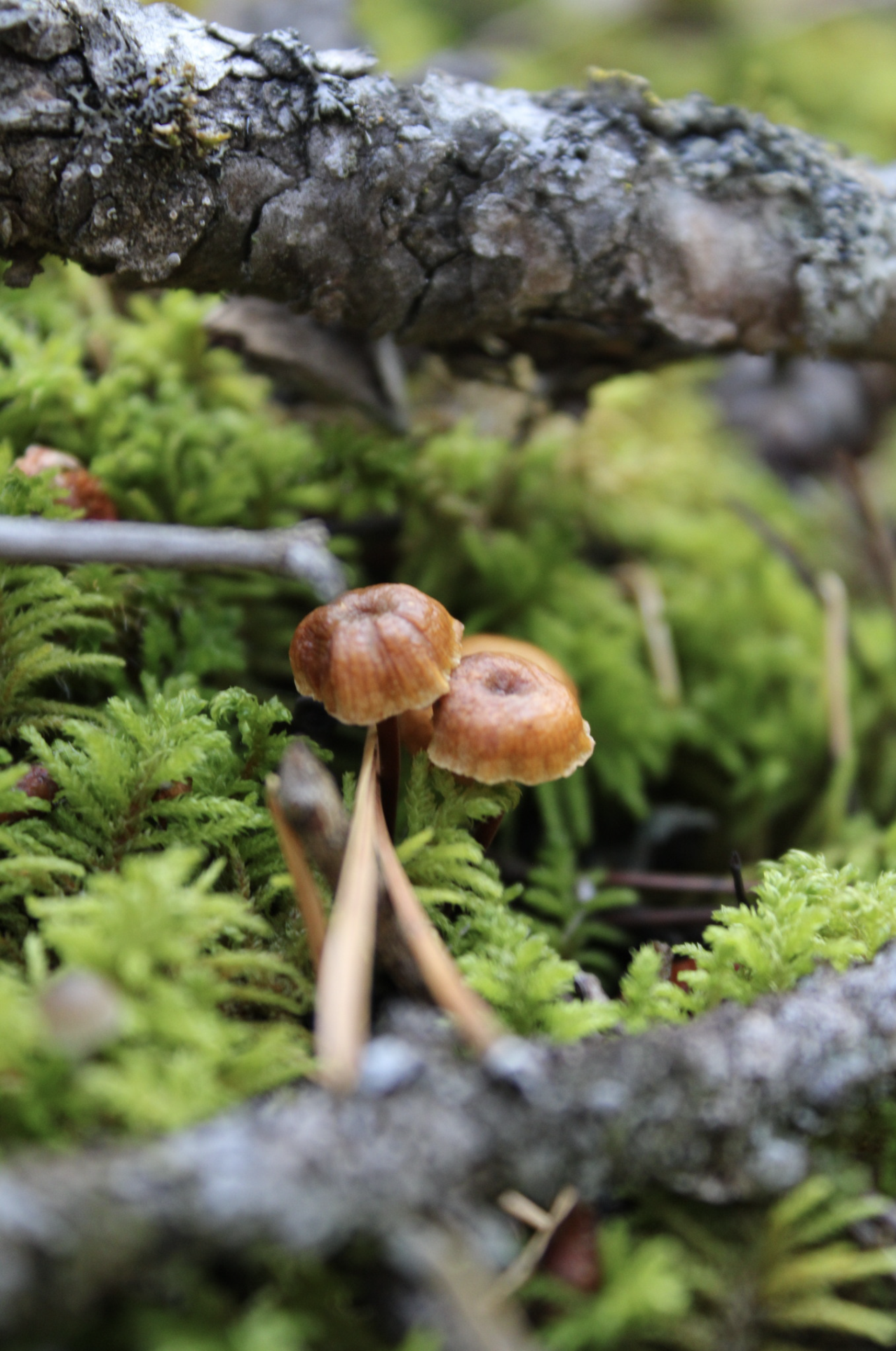
Pinelitter Gingertail mushrooms

In the natural world, life begets decay and decay makes room for more life. Even though we may think of fungi as odd, ugly, or repulsive, and perhaps as an omen of death, they are also an omen of life and of a healthy ecosystem moving through its eternal cycles. The presence of mycelial networks and fungi is a good sign: it indicates that one part of the process is working and therefore so are the others. 

In a similar way, the inclusion of Deaf, disabled, Mad and neurodivergent people is also an indicator of a healthy society— one that can infrastructurally support a broad understanding of human diversity, community care, and provide high standards of living for all its members. 

Last autumn I wrote an essay about my experience attending Sync Alberta 2024. At the time, I was also in Mînî hrpa (Banff, Canada) attending a writer’s residency at the Banff Centre for the Arts and Creativity. Participants of Sync Alberta were encouraged to create metaphors for our leadership styles. I chose mushrooms. Later, for my essay, I described the experience of intentionally walking through the alpine forests of the Banff Centre’s campus, some of the mushrooms I found there, and the inspiration I drew from them. The Mycelial Model of Self-Advocacy builds upon that original text: how ‘odd’ fungi can be a metaphor for the embraced failure and stubborn thriving of disability culture. The Mycelial Model can be a way to shift ourselves into that alternative mindset, so that the constant self-advocacy we must do as D/deaf and disabled creatives, curators, and leaders can be sustainable. 

The Mycelial Model for Self-Advocacy

  • Off-to-the-side thriving
  • Network-based
  • Release spores
  • Respect cycles

OFF-TO-THE-SIDE THRIVING

As I wrote in my last essay for Sync, “You may not want to pay attention to the mushroom, may not even know it’s there. That doesn’t matter. Whether we give permission to it or not, fungi will grow and transform on its own and make a home for itself anyways […] The mushroom’s metaphor for disabled stubbornness— the will to thrive, despite— is obvious”.

This off-to-the-side mindset is the antidote to professional people-pleasing, a quality many disabled arts professionals have picked up along the way. When you get so few opportunities, you’re conscious of scaring away the few you do get. So, you people-please: you accept the token or meagre opportunities, hoping they’ll think of you next time.

What if we happily thrived in the margins we’ve been sent to, instead? Is that even possible? Aren’t we already? While waiting for galleries, governments, societies, companies etc. to catch up, let’s do what we do best and thrive ‘off to the side’. We dream of community, acceptance, recognition— until we get there, if ever, where are we now? Let’s recognize and create meaning here as well.

How can you change or update your workspace so that it not only accommodates your differences but shows respect for them? For example, as someone who experiences chronic fatigue, I need a couch in my studio. From the view on the couch, I can see thank-you cards, awards, and favourite paintings which all remind me of how proud I am of what I do. Taking time to rest and to reflect is exactly what gives my artwork and writing its thoughtful voice. I’m off to the side resting on the couch and it’s a good thing.

While waiting for galleries, governments, societies, companies etc. to catch up, let’s do what we do best and thrive ‘off to the side’.

NETWORK-BASED

Mycelium (my-seal-ee-um) is the name for the root structure and mycorrhizal (my-co-rye-zull)is the word for the network: the vast underground network of both fungal and plant roots that serves as a communication system and resource exchange between different species. Suzanne Simmard, a professor of forest ecology at University of British Columbia, completed field studies in the late ‘90’s which revealed that trees are connected to other neighbouring trees through mycorrhizal networks. She observed a Douglas fir infested by insects using the network to send chemical warnings to a ponderosa pine nearby, and the ponderosa later produced enzymes that would protect it against the same insects.

Be around other fungi. Go to online or in-person gatherings with other d/Deaf, disabled, Crip, Mad, and neurodivergent people. And, if you can, go to these more than able-bodied/neuro-typical gatherings. Grow there and look out one for another.

RELEASE SPORES

The point of flowers and fruiting bodies is to spread pollen and seeds, or in the case of fungi, to spread spores. There are a fascinating variety of ways they do this. Take the stinkhorn mushrooms, which emit odours that are foul to us— often compared to the scent of rotting meat— but are highly attractive to scavenger animals and insects, who will visit, curious about the smell, and carry some spores with them when they scurry or fly away.

Many types of common shelf fungi, which grow horizontally out the side of tall hardwood trees, use less dramatic methods, and simply drop thousands of spores onto the forest floor from their perches high above. Aided by wind and gravity, the tiny spores litter down and are carried off to other sections of the forest.

We can be inspired by this, and litter our life and work with small ‘spores’ of self-advocacy. There are courageous, heroic exclamations of self-advocacy like performances and protests, statements, and refusals… while these are necessary, they’re hard to do over and over. Instead, between these larger gestures, we can pace ourselves and routinely drop smaller ‘spores’ of self-advocacy.

Keep a link to an access reader in your email signature. This smaller gesture normalizes artists and professionals having access needs.

RESPECT CYCLES

In the original 2024 essay, I wrote, “… These small beings will die soon— gingertail [mushrooms] only last a day or two at most. I take a photo, tap my finger against one of the caps, and smile when it bounces gently under my touch… mushrooms are only the fruit of a much larger mycelial network we cannot see. They are only temporary beauties, like fruits on a tree.”

For me, part of a mushroom’s beauty is its transience. Like the passing day and night, the short-lived spring flower, or the red and ochres of autumn: these things are made more meaningful because of their passing nature. While the dramatic life and death of flowers and fruits are an essential period of the growth cycle, it’s the roots underneath that will last (there are mycelial networks in North America estimated to be over two thousand years old).

In the arts, a performance or the exhibition is like the fruiting body on the surface of advocacy efforts. Standards of care, respectful workspaces, and supported artists are the mycelial root system. We can’t put all our efforts into the showy ‘fruits’ and not have any time or energy for the roots; without healthy roots there aren’t fruit for very long.

Learn when to say “not right now”. Set boundaries around time and energy and respect the cycle of art and yourself. Importantly, figure out what those boundaries are before the projects start and not while under pressure and in the middle of it. Set goals for the ‘fruits’ of your labour alongside plans for sustaining the roots.

According to the 2023 Canadian Survey on Disability, 27% of Canadians have a disability that limits them in their daily activities[1]. That’s around 1 in 4. Poor representation and ableist infrastructures may make us feel we are alone in the world, but—and especially when we band together across disabilities— we’re actually in the company of many others.

Though we may start off as someone who walks through a forest or city unaware of the fungi growing around us, we can be taught how to see and find them. We can also, in a similar way, find our fellow spoonies, crazies and Crips. Until we get to the better representations and futures we dream of, let’s make today sustainable and meaningful. It’s today that we are designated as odd, monstrous, alien, or as failures in the eyes of a normative world. It’s today that we can be unapologetic about our unusual minds and bodies, and the different ways we thrive and create with them. Today we can ask, what would a mushroom do?


[1] Statistics Canada, released 1 December 2023

‘

The Speed of Trust: Alex Bulmer in conversation with Sarah Pickthall

Listen to the Podcast

That time-taking shows respect for the others in the room. It says that the leadership model isn’t always controlling every minute or filling every quarter of an hour with a purpose.

‘The Speed of Trust’ on our terms or Taking Our Time.

The Speed of Trust is a leadership idea coined, by Stephen Covey, that values trust building but still has more of an eye on productivity – and rapidity – rather than process.

Alex Bulmer is a Sync Alumnus and award-winning writer, director, actor and dramaturg. Amongst other things she is co-founder of Fire and Rescue Arts and was lead curator of CoMotion Festival 2022 (an international Deaf and Disability Arts festival produced by Harbourfront Centre).

In 2020 Alex took part in Sync’s first online intensive program in Ontario, Canada and shared with Sync her piece about the value of inefficiency. Her leadership metaphor – a vinyl record, chosen because it circles and spirals and takes time to reveal itself. She has since then worked extensively across Sync programs in Canada, UK and Australia.

In 2025, Alex Bulmer met with Sync’s Sarah Pickthall, whilst rehearsing to go on tour in the UK with a new adaptation of Daphne du Maurier’s Don’t Look Now, to shape resources for the new Sync Re-Ignite program. Together they revisited the notion of circling and gathering on our terms as disabled leaders and that a vital part of working collaboratively, curating and co-curating, is considering how we foster and facilitate the conditions that allow trust to develop so that we can bring our whole, authentic selves safely into a creative space.

Time is a malleable and complex notion; in a “one size fits one” society which prioritises efficiency and productivity, it is easy to mistrust slowness. Alex has always instinctively understood the value taking time to of circle around and compost ideas, allowing time to gather. She knows that this slow processing time is critically important to the creative process.

The very notion of a ‘leader’ implies to Alex a figure ahead of the pack, moving that bit faster: “I think it’s taken me a long time, and I am still learning, to trust the virtue of inefficiency, the value of gathering, and the discoveries gained from circling as opposed to going quickly from A to B.”

Rushing to outcomes can be so counterproductive. Experience has taught Alex to be confident in claiming the time to bring a group together: “I’m running a project in Toronto with 3 writers who are blind and we started with a meal together. You know that was in the grant – it’s in the grant that we will have two meals together! Because it’s absolutely part of the creative process. Having that meal together, before we start working as a group, (allows) things to unfold and unfurl.”

It is also a key part of building trust, committing to the people in the room and to taking time to ‘unfurl’: “That time-taking shows respect for the others in the room. It says that the leadership model isn’t always controlling every minute or filling every quarter of an hour with a purpose. It is also time that enables everyone to become part of setting the dynamic, creating the tone and engaging in the conversation.”
For Alex, blindness can create its own time zone: “I have often found myself comparing my way of participating in a group to others, and I can conclude that I’m not ‘keeping up’. The very idea of keeping up immediately suggests that there’s some kind of a competition, or that there’s one way and that you have to keep up with that one way.”

Alex has worked to reframe that notion of ‘keeping up’ into something that works positively for her: rather than keeping up with someone else’s standard, she thinks of keeping up in literal terms: keeping the physical body upright, and in terms of values. “How do I keep upright in these environments? How do I go at my own pace, and establish my own values in a way that that will keep me up?”

Part of this is being aware of what is in her control, and what isn’t.
“I can’t control the level of romanticism or exceptionality or box ticking that’s going on in a space, but I can decide how I am going to enter that room, what I’m bringing into that space… taking a moment before entering a room, just to breathe and imagine oneself in your own body, to feel your feet on the floor, these are simple things but they actually help – when things go wrong just take that moment, take that time, feel your feet on the floor, feel your breath, feel your feet on the floor.” When people put barriers up or make assumptions that knock you, Alex suggests taking a step back and keeping yourself up: “Don’t keep up with them – keep up with yourself!”

Being the only disabled person on a project can make this harder. “There can be so much pivoting around my needs. And that can be a benefit, or it can actually go in the opposite direction, for example there may be an assumption of needs which aren’t there. There’s definitely a real focus on me. Whereas if I ‘m working in a with other disabled people for me that’s where the really beautiful, brilliant navigation and negotiation of peoples’ differing access needs, differing way of working, to me that’s where the magic really exists.”

When it comes to trust, Alex also recognises the importance of allowing time and space for participants to move in and out of activity, allowing them privacy and quiet time within the group as well as full engagement. It can be hard to not allow previous negative experiences to impact on the here and now. “If you’re ready to be here but not ready to expose too much too soon, that HAS to be okay.”
And when we allow for the speed of trust on our terms, creating a pace which moves with our own self and the participants and honours the creative process? Then we can change the assumptions that give speed primacy, and make our considered, considerate ways of working the typical ones. And that, says Alex, benefits everybody!

The unacknowledged rollercoaster of being disabled-led: Jo Verrent

A black and white photograph of a rollercoaster with winding tracks in the air set agains a clear evening sky.
Picture Credit: Kristin Kokkersvold

It’s not enough for disabled people to make art, the context they make it in matters too. 

I’m the director at an organisation called Unlimited which commissions disabled artists to create exceptional work. At Unlimited, we describe ourselves as ‘disability led’. That means our staff, our board, our core decision making processes are all made by people, groups and teams that are as a minimum 51% disabled people. 

We are proud, delighted and determined to be (and to stay) disabled led – it matters hugely. It’s not enough for disabled people to make art, the context they make it in matters too. 

Any art making by disabled artists can, of course, be brilliant. Historically however there has been distortion, censorship, control and coercion within some contexts where disabled artists have made work – think of all the collections of work that exist from hospitals and asylums that are named after the doctors of patients. Where the artists are unknown, the doctors or institutions own the work, gain the credit and the cash. Think that’s in the past? I can name a large number of directors, choreographers, curators and collectors who are non-disabled and still working from this model – all far more prominently acclaimed (and well paid) than the disabled people they collaborate with or whose work they benefit from.

But this isn’t just about why it matters, it’s about what it costs – not only in cash terms.

But let’s start with the money. We recently calculated that ‘in the last six months alone Unlimited has spent over £20k ensuring meetings and processes are accessible for our 93% disabled-led board and our 83% disabled-led staff’. That’s £20,000 more than an organisation that didn’t involve disabled people would have to spend, and that’s only half the year.

And those access solutions don’t just magically get put in place – there is labour in the determining, contracting, briefing and supporting access providers and organising other access support. The figure above doesn’t include that labour.

And there’s more work internally too – such as ensuring the team all have access riders if they need them and that they have space to adapt to what other team members need, or ensuring everyone who works with us has disability equality training so we share a common base level understanding and terminology.

There’s the work on policy adjustment. Most organisations don’t really look in detail at how policies impact on disabled staff. We do. For example, at how in the UK sickness absence policy terms and conditions are different from disability related absence (which doesn’t have to come from your sick leave allocation). We’ve had to work through and improve our policy and to determine different levels for all our disabled staff. We take one policy a month – our expenses policy, our access policy, our data policy, our flexible working policy… basically all our policies need to be seen through a disability led lens and adjusted. 

All the above is easy to write about – the rest less so.

..It’s not the bruising interactions with external ableist structures, painful though they are, it’s the cumulative impact of those interactions.

Reflecting personally here, the biggest adjustments aren’t the internal ones, they are taking our disabled-led organisation into the world and meeting the ableism of others, which I wrote about recently here. And even then, it’s not the bruising interactions with external ableist structures, painful though they are, it’s the cumulative impact of those interactions.

It gets to me. It makes me doubt myself. The number of times one hits barriers, it would be easy to assume that ‘they’ are right and you are wrong. It starts to nag that surely if barriers should be removed and they aren’t then it’s because somehow, they are needed or necessary? Now intellectually I know that barriers exist because people setting up systems don’t have the knowledge, time, resources or care to make them accessible. They don’t think about it and they take short cuts. Often the damage they create isn’t deliberate. Morally, and often legally (in the UK), I know that I am correct to push for reasonable adjustments, adaptation and change in line with the social model, to make the world more accessible to all. Emotionally, I start to internalise that feeling of being too much, asking for too much, being a burden.

If I’m already exhausted, this can quickly spiral into a ‘I’m not good enough’ or ‘I can’t do this’ narrative which can be damaging. And I’ve never been more exhausted trying to run, let alone develop an organisation whilst the world burns around me.

Austerity, a pandemic, war, a political system (UK and worldwide) in disarray, cost of living increases off the scale, reduced access to healthcare and access, energy crisis and so much more pile on top of each other making everyone scared, unsure and nervous. Add to that a label of ‘clinically extremely vulnerable’ to covid 19 (like myself and a number of my colleagues have), the UK’s decision to forget covid is even here and just carry on ‘as normal’ despite raging numbers of both covid and those experiencing long covid symptoms, and perhaps it’s easy to see where the exhaustion comes from. 

A salvation is finding comradeship within and amongst our disabled led peers and allies –  people who ‘get it’, places where I – and they – can take off the armour we need to work within the world and simply be without apology or excuse. 

We see a mistake and we go for the attack, even with those in our tribe, often publicly calling out rather than privately calling in. 

Although even in those safe places, its sometimes impossible to truly relax and take all our guards down. We are human after all, and everyone is tired and taut. We see a mistake and we go for the attack, even with those in our tribe, often publicly calling out rather than privately calling in. It’s easy to allow feelings of envy or jealousy to bleed into snide comments or backchat, especially when budgets and opportunities are squeezed and panic starts to rise. We set ourselves impossible standards – and we expect them of others too. Life is hard right now.

I have to remind myself often to first be kind. This was something that previously would have been second nature but something the last three years seems to have stripped away, grating a slither more empathy off me with each new challenge to face.

First be kind – as we never know what others are facing. Second be kind – especially to my disabled kin who are as exhausted as I am as we face more barriers now than ever, including the re-emergence of many we thought we’d already removed. And third be kind – because it’s the best, fastest and most positive way to make change in the world. 

It is always a choice. You can water the seeds of fear and anger if you want, but I want to choose to water the seeds of compassion, understanding and kindness where I can.

Alex Bulmer: Leadership – The Virtue of Inefficiency

Alex Bulmer wearing black glasses looking upwards to the sky

Alex Bulmer joined the Sync Canada Ontario programme this June. An award-winning writer, director, actor and dramaturge and Artistic Director of Common Boots Theatre, co-founder of Cripping the Stage with British Council Toronto, and the Lead Curator of CoMotion 2022, an international Deaf and Disability Arts festival produced by Harbourfront Centre. Alex shares the spin and turn of her leadership metaphor and more besides.

A needle sat upon a vinyl record - it’s centre decorated with a fuscia pink and orange design.
‘A record album spins around…’
Audio of ”Alex Bulmer: Leadership – The Virtue of Inefficiency

A record album spins round and around as the needle lowers its tiny metal tooth into an imperceptible groove. Metal and vinyl: opposite elements, yet part of a collective whole.

This is my leadership metaphor – a vinyl album in motion delivering a series of artfully-arranged sounds.  On their own the sounds produced by single instruments hold energy (violin/electric guitar) yet somehow together they transcend expectation (orchestra/rock band).

The idea that effective leadership can actually go around in circles intrigues me.  According to the Oxford dictionary, “efficiency” can mean ability, coherence, labour saving, systematic, productive, effective. To me, the word suggests doing more with less, getting quickly from point A to point B, profit, machines….and even sight.

While swimming in a hotel pool in Los Angeles in 1997, I discovered the virtue of inefficiency.  I was on a solo trip from my home city of Toronto, or more accurately, I was giving myself “travel therapy” as an escape from the reality that I was “going blind”. On my first day in L.A. I asked the hotel staff for instructions to the outdoor pool, then used my cane to find it.

After several minutes tapping cement and patio furniture, I felt the end of hard and the beginning of liquid.   I knelt down, and reached with one hand to confirm that in fact I had found water.

Positioning myself at the edge, I lowered my body into the pool.

Once in it, I realized I had no idea of its size, shape, or depth. Reaching out, I felt the pool wall and traced it, swimming round and round for quite some time to comprehend its shape and size.

I discovered

cracks in the concrete

chunks missing, filters

and flaps

I noticed the “slap thwap” of water against the pool edge

it washed into a hollow sound by the ladder

and

a “slap echo thwap”

underneath

the diving board.

Slowly, gradually, through cycles of not knowing to knowing, I came to understand…

the pool shape —

was that

Of

a kidney bean

round at one end and narrow at the other.

I discovered the pool, gathering individual pieces, that, with sight, would have been eclipsed by the whole.

“Going blind” – two words which had, until that moment, suggested loss, a lack of awareness, a falling away.  But there, in that particular bean-shaped LA pool, this “going blind” felt like potential, a becoming – becoming one who circles, a collector of “what’s this”, a perceptual archaeologist.

And so, to circle back to my vinyl metaphor…

It continues to spin…

the metal needle remains connected,

moving along the groove.

Notes, rhythms, phrases, beats of time –

the unexpected, an emergence,

a work of art,

a song.

I am my metaphor. Blindness is a kind of time zone. Perceptual archeology nourishes a sense of meaning and connection. With this, I – and others should thrive. But we live in a “one size fits one” society, designed to streamline most of what we do, to make us “efficient”.

We need to build more liveable futures imagined and designed to enable rather than disable. Being enabled, or having access needs met, should not be a privilege held by some. It must be a shared public value, along with clean water, public health care, electricity and roads.

Imagine a Canada wide access grant to cover personal support workers, interpreters, adaptive technology, direct funding available to those who experience barriers or are at risk of exclusion.

Such a thing exists in other countries. Imagine shifting the politics of “help” toward transactional rather than charitable.

Imagine beyond the assumed….

Our time is now: Jo Verrent

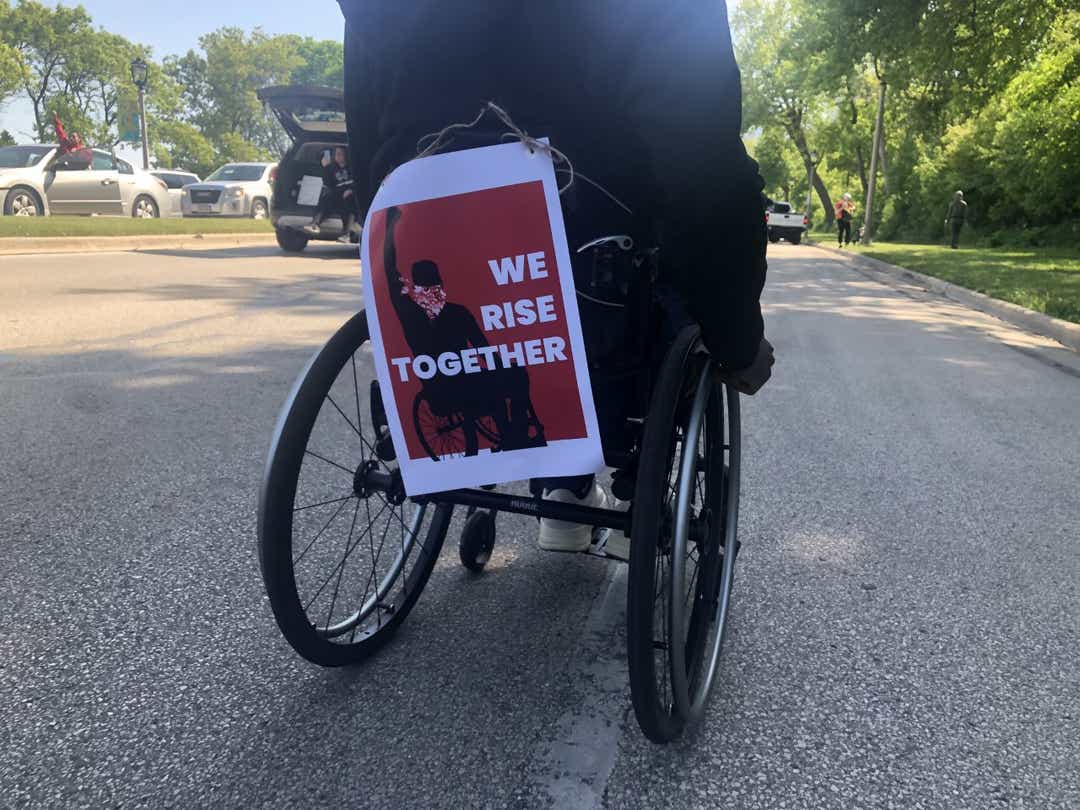
a person in a wheelchair facing away with a poster on the back of the chair saying We Rise Together
A picture of legs in a paddling pool and a shadow of a person with a hat reflected in the pool.

Leadership comes in many shapes and forms. It no longer looks only like a single standing figure (usually tall, male and white) if it ever did.

Globally, we still need more diversity in who we see in our programmes, on our stages, on the walls of the galleries, around tables, in meetings, on the Zooms. Each country will have its own unique issues and its own unique barriers. Yet we all need more direct representation from disabled people within our arts sectors and ecologies, but we also know that’s not the only way to lead.

This pandemic has showed us other places where influence also lies. We know about the whisperers – both the formal and informal advisors; those who lead by sector expertise; those who can galvanise communities and amplify their demands; the power of demonstration, the power of social media and those who seem to influence simply because of who they know.

Disabled people, in the arts and other spaces, have been claiming territory across all these domains. Look at the way UK’s Lisette Auton reminds us that this new online world is not inclusive of all, Australia’s Caroline Bowditch reminds us just how resilient disabled people always have been, Singapore’s Lily Goh in has pivoted her YouTube channel to both ensure Deaf people have access to relevant information and also teach sign to others, and Canada’s Ophira Calof, Kaileigh Krysztofiak and Dawn Jani Birley present solution finding as the norm, to name but a few. In the UK, disabled artists and cultural leaders have come together under the hashtag #WeShallNotBeRemoved, forming an alliance to ensure the disabled voice is heard as the country plans for the ‘new normal’.

As experts by experience in adaptation, social restriction and on-line access – largely due to the inaccessibility of the world before – we have been able to use that knowledge and hard-earned wisdom to help others and challenge those that seek to make ‘the new now’ inaccessible too.

Is leadership different now? Is the door opening up more easily to us? Will it be different in the future? Will it stay open or do we need to wedge it now?

We have shown that there are many, many ways to lead. You do not need endless energy to lead. That you do not need to do so alone. That our unique ways of being in the world can be seen as advantages and not disadvantages, can provide new perspectives and allow new insights.

It will be interesting to see what sticks and what does not. Whilst we are in lockdown, I am more equal. My fatigue that is exacerbated by travel, is lessened at home and, with captions, I can attend and follow the Zooms and the Teams and the others and contribute. I can also go sit in my greenhouse and stick my feet in a paddling pool if they swell.

The equality of those spaces and the urgency of our times has made me bolder too, less cautious to say what I think. Perhaps too this comes from my lived experience?

Being on the shielding list in the UK means anticipating seismic changes in any work-based risk assessment – what happens if I get ill, or get really ill, or die? Facing up to, and planning for, these possibilities is horrendous in theory but I have found it strangely satisfying in practice, and ultimately confidence building. I believe it will make me imagine new riskier possibilities more readily in the future, be more prepared to imagine the unimaginable.

I am aware of more disabled people being invited to more meetings to talk about the future – although the disabled people are still the same ones and the meetings are often not the ones from which decisions are made. I’m also aware that the decision to reopen in many countries is being driven in the name of commerce, rather than science. I was bored waiting to be asked for an opinion, so I developed a manifesto of my own.

We have to come to the fore, it is our time. We have to band together to make our opinions known, our voices heard. We wait in our individual homes, in our multiple countries, in our single world to find out what happens next. But we can take action, not wait passively. We can fight, influence and do whatever we can to ensure, as the International Disability Alliance says so clearly, that we move forward leaving no-one behind.