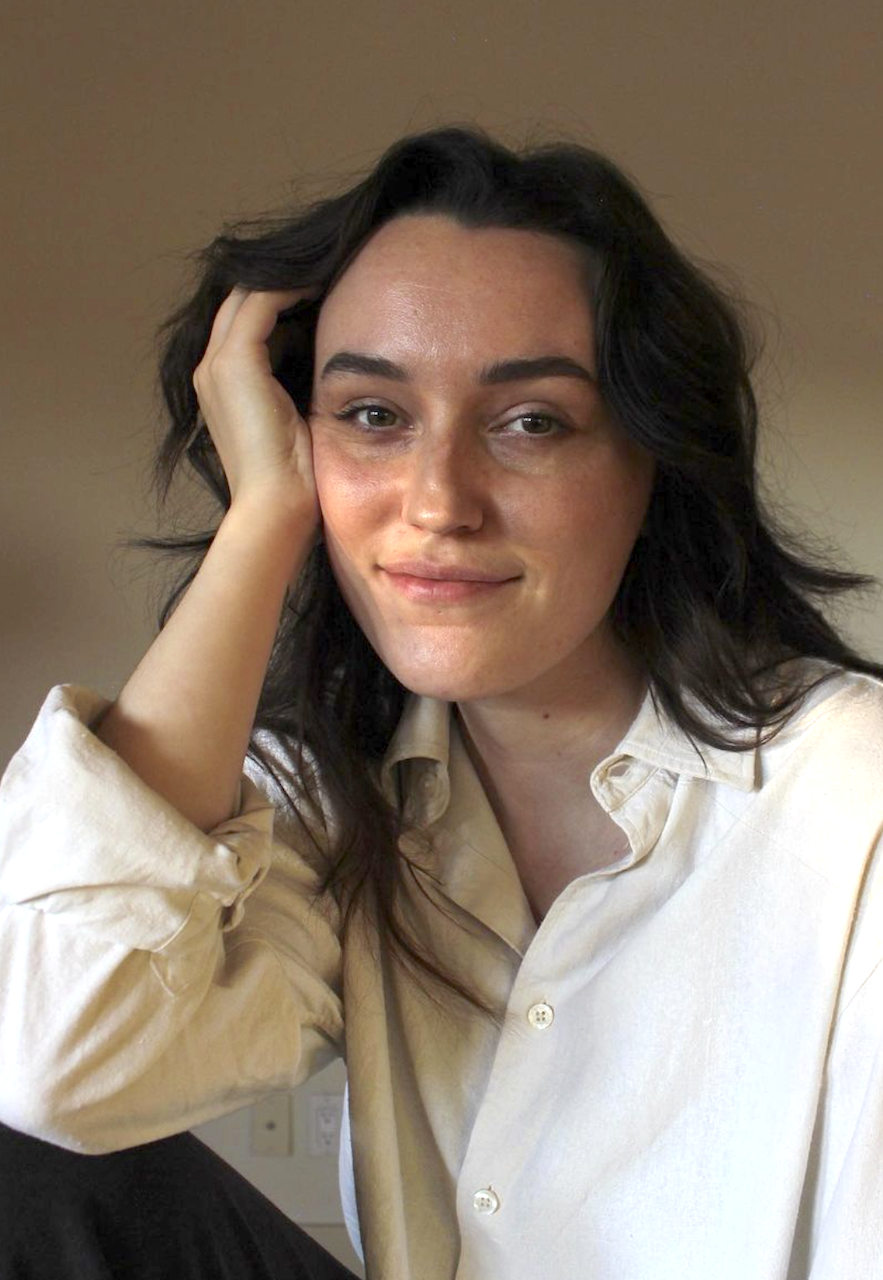
Louie Fermor is a disabled artist in Calgary that uses art to explore portraits and storytelling.
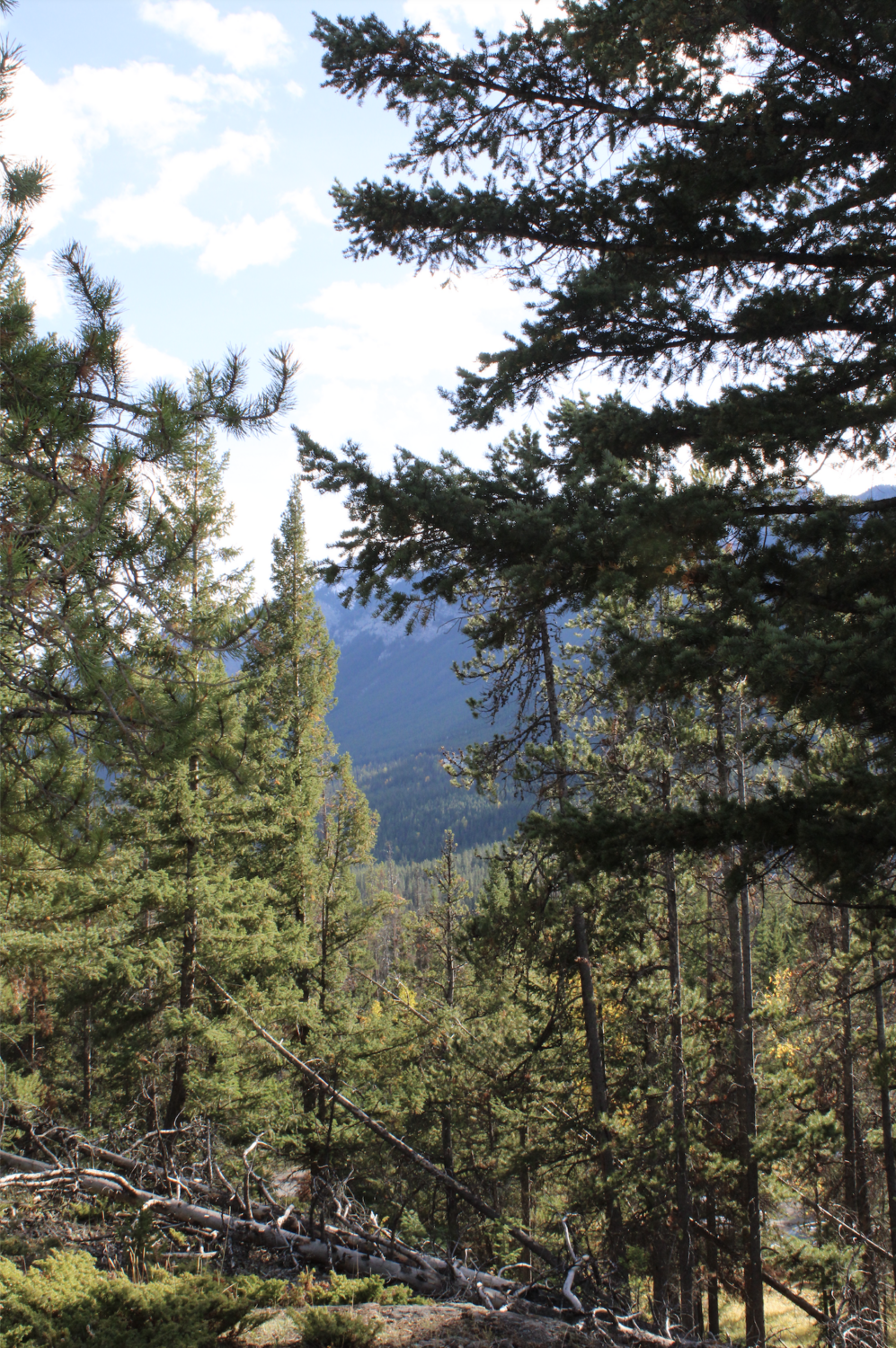
Through the green-needled canopy above, I can see innocuous white clouds. The blue sky.
Around, quiet wind brushes through pine boughs. It’s the authentic version of a sought-after ambient sound, the ‘white noise’ we’re always trying to replicate. The hundreds of smaller sounds in harmony, like a large crowd of distant voices or the countless tiny collisions between water waves and grains of sand. Or wind: when airy molecules (hydrogen, carbon, oxygen) are pushed and pulled by temperature drafts and sift over each other through the open, orchestral chamber of earth’s atmosphere. Here in the alpine forest, the wind’s waves are punctuated by the sharp crunch of leaf litter under my boots, the pirouetting, dual-note chirp of a nearby thrush.
I’m walking through the autumn forest of Minhrpa, on the side of Sacred Guardian Buffalo Mountain, otherwise known as Banff, Canada. I’m attending a literary residency at the Banff Centre for Arts and Creativity. While meeting with other writers, I’m also in the digital company of a group of disabled creatives wanting to lead. The two are a wonderful compliment to each other: Sync Alberta’s intensive course for disabled arts and culture leaders, and the Banff Centre’s Early Career Writers of Fiction residency. People wanting to connect, to make, to lead, wanting to be courageous and to feel. All kind, good souls.
I still need to be alone most of the time anyways. I’ve learned that my neurodivergent body and mind work at their own pace, sometimes faster and sometimes slower than others (always oddly). I often need to go off somewhere and re-set my pace because I’ve forgotten myself somewhere along the way— I’ve been calling these ‘regulation snacks’. On days or weeks when I know I won’t be able to rest and be alone, I’ll make sure to schedule in a ‘snack’: a rest that will nourish me for a while until I can finally get a full meal (a true rest, true solitude). I try to make sure and pack ‘snacks’ for residencies, courses, events, or any time that I’ll be around others for long periods.
That means today I’m walking through the autumn forest, wandering among spruces and lodgepole pines. For an hour or two, I’ll set my body to the pace of the land and set my mind to the slower, benign pace of its most secluded inhabitants: fungi.
While I’m walking, I mildly clap my hands periodically, letting the sound echo over the hillocks and stones, between the trunks. In Banff, you’re warned about wildlife: elk, deer, infrequent bears. On mountain trails, you scan the path ahead and the forest beside, watching out for them. But you want them to know you’re there too, so no one’s surprised to see each other. That’s when things go bad. So, you make noise every once in a while. If I’m kneeling to photograph a specimen, my hands busy with the camera, I’ll whistle. It doesn’t matter what— some tune or repeating series of long chimes, something like a bird, something like a song. Just something that lets others know I’m here.
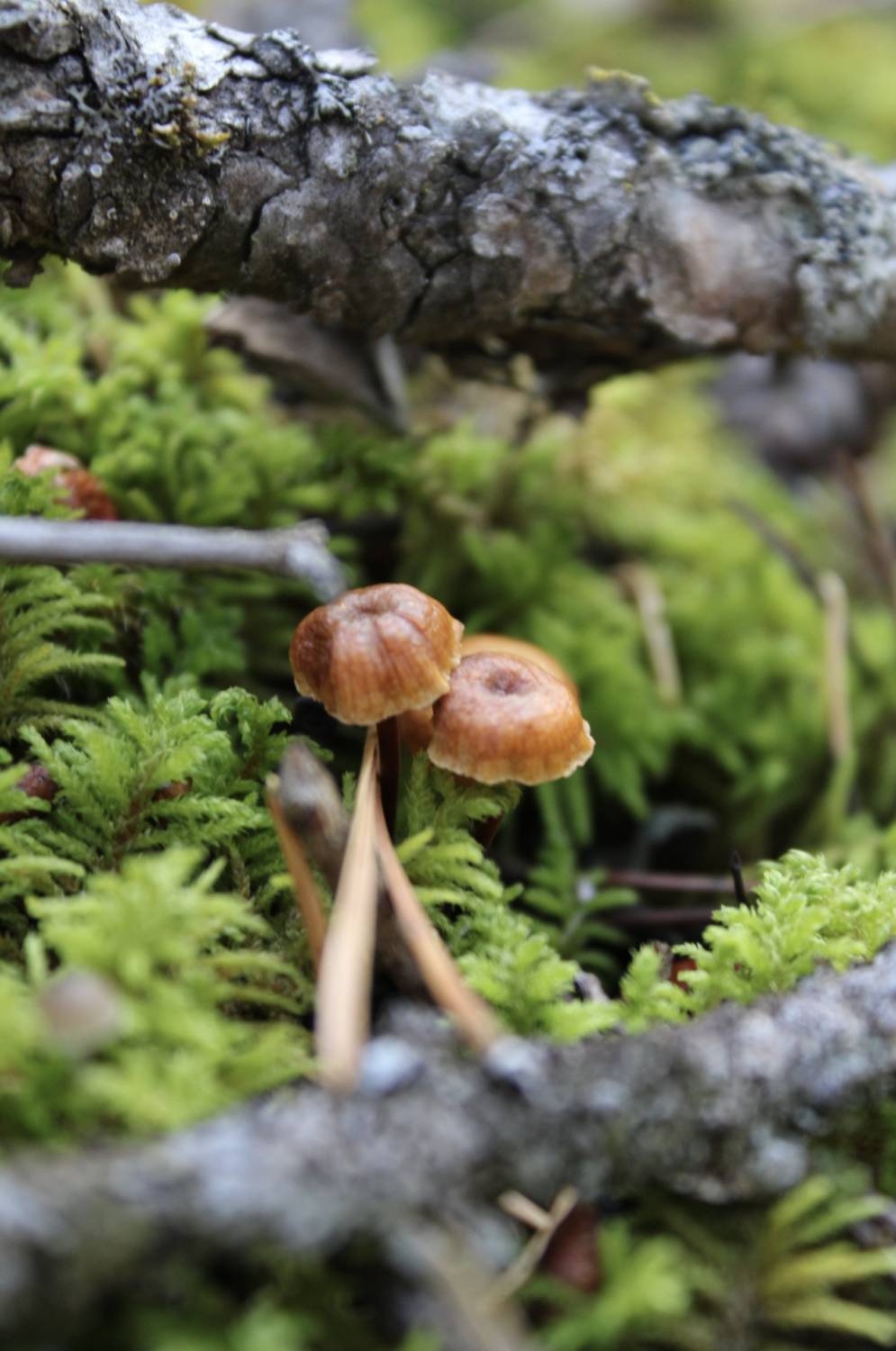
These ones are pinelitter gingertails. They’re growing among moss that thickly piles at the bottom of a spruce. Their thin brown stems, only tall as matchsticks, are impossible to see among the thick botanical carpet. So, the orange-brown caps that balance on top of them, a dozen tiny amber domes, seem to float above the forest floor. These small beings will die soon— gingertails only last a day or two at most. I take a photo, tap my finger against one of the caps, and smile when it bounces gently under my touch.
Mushrooms are only the fruit of a much larger mycelial network we cannot see. They are only temporary beauties, like fruits on a tree, meant to spread spores for the ‘roots’ underneath. Some may be finnicky and need highly particular substrate, like a rare hardwood or soil dense with the nutrients of recent decay… but they are all part of an otherwise holistic and vast, underground fungal system that’s impossible to quantify from the surface (one, in the Blue Mountains in Oregon, USA, is estimated to be ten square kilometers wide). Though they may appear secluded, strange, no mushroom is alone. None are truly independent from others, from the greater ecosystem, rare and unusual as they may seem in our eyes.
Many fungi are classified as parasitic (correctly, in natural science terms). There are others in our world known as parasites. Bottom-feeders, strange, unworthy, ignorable. You may not want to pay attention to the mushroom, may not even know it’s there. That doesn’t matter. Whether we give permission to it or not, fungi will grow and transform on its own, and make a home for itself anyways. During Sync Alberta, participants were asked to create a metaphor of their leadership style, their experience as a Deaf or disabled person. The mushroom’s metaphor for disabled stubbornness, the will to thrive despite, is obvious here, I think.
I used to feel unseen and odd, I often still do. Many Deaf and disabled people feel this way. Now, after a few years spent in the company of fellow ‘different’ types, I know that the feeling of being a strange outlier is not rare at all. Rather, it’s the experience of the majority: few people are recognized in an individualist society like ours, disabled or not. Many are ignored, never known. Therefore, succeeding in individualist culture is rare, and to fail is… almost universal. Paradoxically, to be ‘unseen’ is to have a shared experience with many: to be a part of the many unseen who make the world turn, the forest grow.
Almost everything is ‘failure’ in the alpine forest— the cold has made you small compared to southern neighbours, you’re rotting by the end of the day, or being ground into dust by elk hooves. Or maybe you made the mistake of being a late bloomer, only starting to finally grow right before the first snowfall.
I think failure is beautiful. I am grateful to be among it, to rest and set my pace and heart to it, at least for a little while before I go back and join the others.
Paradoxically, to be ‘unseen’ is to have a shared experience with many: to be a part of the many unseen who make the world turn, the forest grow.
Louie Fermor
Other Leaders
-
Salima Punjani
My work is soft and sweet and tender. I would say it is strategically…
-
Dawn-joy Leong
I will always remember SYNC for providing me with the Clement Space — a…
-
Shivanya Ra
As creators, changemakers, and “crippers” of spaces and language, it is imperative to treat…