Category: Blog post

HOW WOULD YOU LOVE IT TO BE? Ruminations on Disabled Coaching 

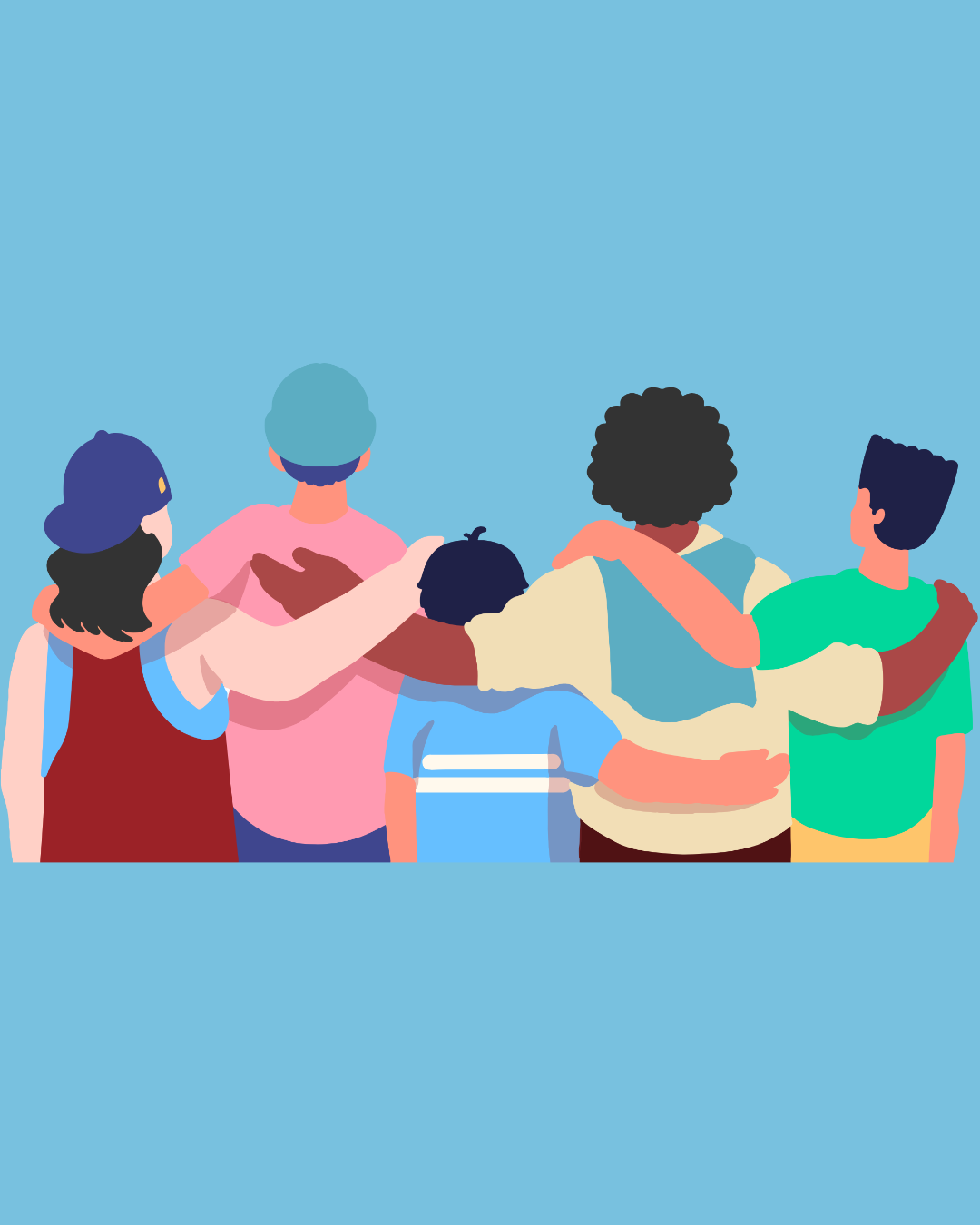
A graphic illustration of people in a line with their arms around each other.

Kristina McMullin

Recently, Sync hosted a conversation with a group of Disabled and Neurodivergent coaches in Canada and the UK to explore the nuances and singularities of Disabled coaching, what brings us to coaching, and, and what we harness for ourselves and our communities in coaching relationships. Coaching practices are, inherently, distinct from mentoring, facilitating, training, or therapy, Disabled led coaching, even more distinct. Disabled coaching creates and environment rooted in a conviction of holding time and space for disabled bodies and minds to be supported, maintain their own agency, and create a deeper knowing of the self. When disabled coaches provide this time, space, agency, and self knowing to their communities, they are, in turn, provided with time, space, and agency to become and to know ourselves on a deeper level. Disabled coaching offers a sense of collective liberation from the barriers and difficulties we are faced in an ableist culture. 

SPACE AND TIME 

Disabled coaching gives us permission to take space, to take time, to take our time. It is a relationship and process that creates generative and even regenerative space for folks to think, to think about their lives, their options, their possibilities, their futures. 

For disabled folks, we often refer to things as having or taking “Crip time”; Kelly Frisch defines Crip as “opening up with desire for the ways that disability disrupts.” Crip time welcomes the way that disabled bodies and minds disrupt normative understandings of time. How long it takes to communicate a thought, how much space it takes to make a decision, the returning we do to a previous time in our lives, the way we cherish opportunities to carve out space for our coaching journeys. 

Disabled coaching welcomes it all. Disabled coaching offers a framework to hold space and disrupt time to honour each individual, their needs, their wants, their desires. At the same time, disabled coaching holds time and space for the coach themselves. John Kelly shares “My coaching practice gives me permission to create space.” 

The taking, the giving, the permission to take and give, and the receiving of space and time is inherent to Disabled coaching and an integral aspect to its power. 

SUPPORT

Disabled folks are entitled to and worthy of support, coaching is one way for folks to receive it. Disabled coaching does not assume the coach has the sole responsibility of offering support, but has the opportunity to create a container of support for the individual to both be supported and build a practice of and capacity for supporting oneself. 

Coaches who are dedicated to disabled coaching speak of deep listening, attention, kindness, compassion, calmness, and open, inquisitive, questions, as ways to build and form a container of support for folks to look inward and grow out. 

Many disabled coaches offering this support, know first hand what it feels like to not be support and create a practice that resists this norm. By centring the support of disabled folks, disabled coaching becomes a type of activism that makes the world more inclusive, safer, and more joyful, for disabled folks. 

AGENCY

A key component of disabled coaching is centering agency, agency of the individual receiving the coaching, and the coach themselves. Coaching continually affirms agency by remaining open and flexible to the pathways and choices that are made, by centring 

The goal of disabled coaching is to support people as they discover what they are called for and as they create a life that can maintain and sustain that. Disabled coaching does not enter into a relationship with a set goal or objective, or definition of success, it welcomes the agency of each person to define success for themselves. 

The coaching container gives permission for the mind to think and feel, and for the body to express. The thinking, feeling, and expression, build a practice of connecting with our agency. 

Coaching also requires the coach to be in touch with their own agency, Alia notes that asking yourself as a coach, what is my motivation for this, by knowing a motivation, coaches can guide folks to finding that for themselves. The coach becomes empowered to step into their own agency, Alia asks,  “What kind of coach would I be if I don’t go and follow my dreams?”

SELF

Disabled coaching is, at all times, a process and relationship that honours our authentic selves. A coaches goal is to use their skills to allow the coached individual to tap into the truest self. To go away with the barriers and oppressions we experience in society, to move away from outdated lessons we have been taught, about ourselves and the world, and 

Coaching requires us to be fully present, fully curious, and open to contentment in the answers and directions that we are drawn to. 

For a lot of disabled folks, coaching is a form of accessible work, it’s something that can be done with our access needs being met, in a community that won’t 

When coaches work with intentionality and curiosity for their community, they build the skills and capacity to be intentional and curious about them selves and their motivations. By creating space for community to become themselves, we find truer versions of ourselves. 

For disabled coaches, the goal is not to get to an externally defined end result or goal, but to support the work and transformation that occurs when we go through the layers of ourself to discover our dreams.

Reflections from the Twilight Zone

Belinda Locke stands next to Kristina McMullin. Belinda wears a seajade dress, she smiles and her dark black curly shoulder length hair frames her face. Kristina has her hair hair pulled back. They both wear lipstick.

Belinda Locke and Kristina McMullin

Belinda Locke stands next to Kristina McMullin. Belinda wears a seajade dress, she smiles and her dark black curly shoulder length hair frames her face. Kristina has her hair hair pulled back. They both wear lipstick.
Belinda Locke and Kristina McMullin – Sync Twilight Facilitators

Meeting in person together in Summer 2023 when Sync was in Toronto, Sync Leaders, Belinda Locke and Kristina McMullin reflected on the Sync Twilight a programme they both had trained in and delivered on in Winter 2022 and Spring 2023 online.

I’m Kristina McMullin (to the right in the picture) and my pronouns are she, her, and I’m a white, cis gender, visibly disabled woman, who works in the arts, largely disability arts, alongside academic research and a few other things here and there.

My passion in life is community building and connection. An introvert by nature, I like being challenged by people and my work and the ultimate challenge is community building because it makes me less of an introvert. And I like being less than an introvert! I like to do projects that feed my soul, and make other people feel seen, heard, and desired in community spaces. My mission statement as a human being, is to disrupt systems while being gentle with humans, to tell the truth in a way that is regenerative, to honor imperfect process and to leave room for joy and laughter. And try to do better, always.

That’s why I came to Sync because there’s an alignment of values there. I had met Sarah and Jo in the summer of 2020. It was on the first fully remote Sync coaching in training leadership, which I did from my home in Toronto, where I felt a true sense of alignment in this desire to create community, create spaces, be a disrupter while remaining true to those principles of care and support Sarah so beautifully demonstrates.

Sync Twilight (which brought Kristina and Belinda together) seemed like an obvious next step. I’ve never worked with anyone really outside of Canada and the UK, and I think that it’s great to build these like hyperlocal communities but that disabled folks are always part of the larger global community.

I’m Belinda Locke, pronouns she and her.  I live in Melbourne, Australia on the land of the Boon Wurrung people of the Kulin Nation. I’m a white, cisgendered woman. I identify as disabled. I’m a theatre maker and Director, and create multidisciplinary work where I collaborate with people from lots of different art forms. In all of the work that I do, I’m looking to create opportunities for other people to share their work alongside my own.  Sometimes I’m curating a festival programmme, or sometimes, like I’m going to be doing next month I’ve got a show opening but I’ve also commissioned other artists to create work on the same theme. I think it’s really important to show different perspectives from people with varied experiences of disability as well as different cultural backgrounds.

I did the Sync leadership programme way back in 2014, and it was so important for me.

I was early on in my career and I was definitely the baby of the group! It really helped to spur me on in a direction where I was able to work with the community in Australia, and Brisbane in particular, to set up a national disability arts festival called Undercover Artist Festival. That was really enriched from my experiences with Sync and from the Sarah Pickthall’s coaching, and the work that I did in person with Jo Verrent.

When I heard about Sync Twilight and this opportunity to co-facilitate a group with you, Kristina, I leapt at the opportunity.

I would say Sync Canada was my first experience of online training.  Having that kind of experience and being so supported with such care and flexibility. I loved it,

Kristina McMullin

I would say Sync Canada was my first experience of online training.  Having that kind of experience and being so supported with such care and flexibility. I loved it, and have always kind of judged other online development courses against Sync because it was so responsive.  It made it possible to tell the truth and be vulnerable.  My biggest goal with Sync and with Sarah, has been like, how do I or how do disability identified folks be vulnerable, while still staying safe?  Sheryl Sandberg and Brene Brown talk so passionately about the value of being vulnerable, but they’re two women who have oodles and oodles of financial privilege, career privilege, able bodied privilege, white privilege: you know, Sheryl Sandberg isn’t becoming the CFO of Facebook by like, disrupting systems!

Yes, it’s a different position to be in, to our experience. And, you know, when I say our experience there are many different experiences within the disability community, but often, I think you’re viewed as vulnerable to some extent, automatically. And so, the decision to harness that and to find strength in vulnerability is a different kind of process.

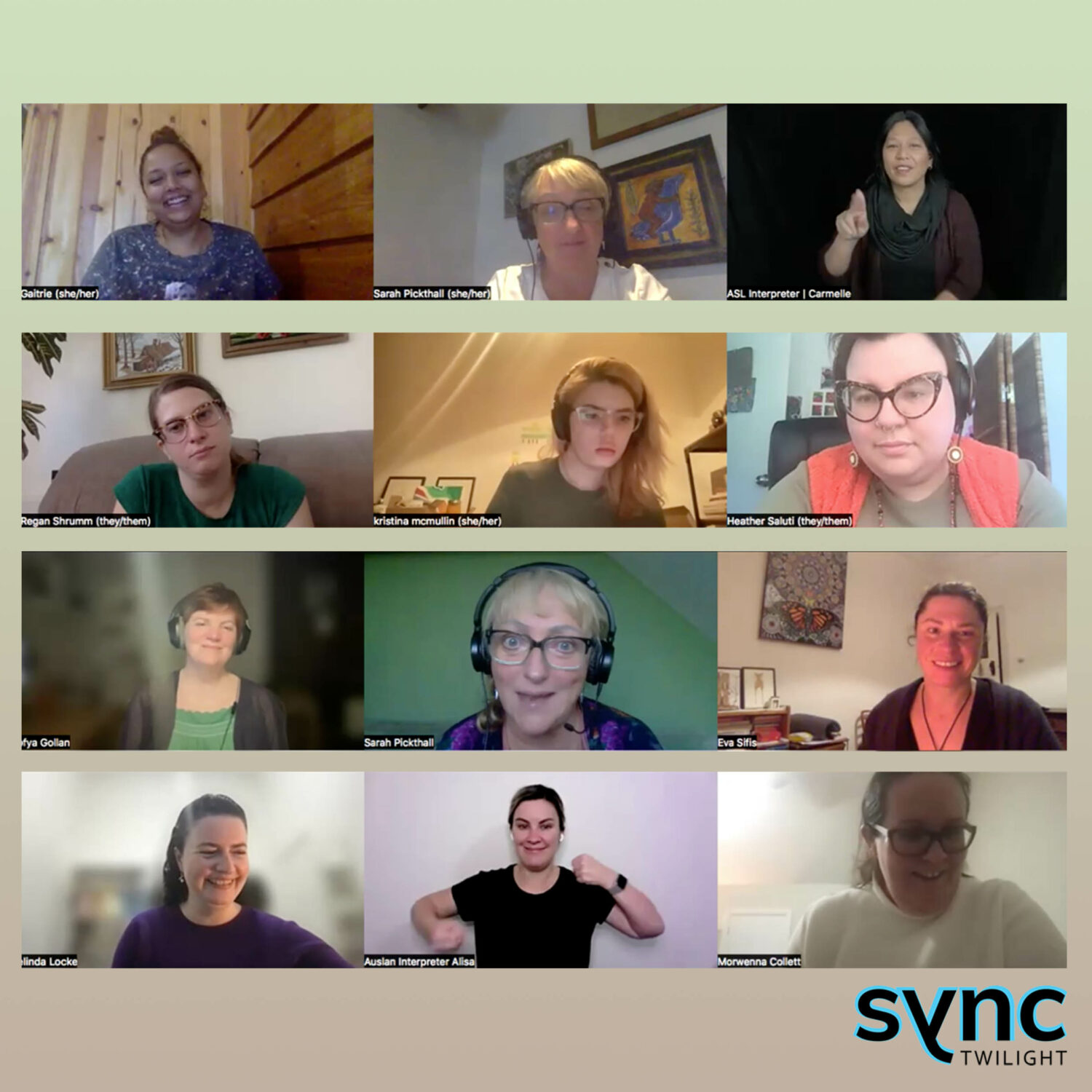
12 people in Zoom: Smiling, thinking, 4 facilitators from Sync Canada and 4 from Sync Australia working alongside ASL and Auslan interpreters with co-founder Sarah Pickthall
Sync Twilight Facilitators – Group Training session 2022

As co-facilitators in Sync Twilight, we both went through this process of facilitating sessions with a small group of people. Disabled folks from Canada and from Australia online. And we did this particular kind of coaching, using action learning. Which, in essence, I would describe as being about one of our peers coming to the meeting with an issue that they’re having in their professional life. Then the rest of the group really probing with questions that are open and not leading, and helping the person themself to find the answer to the issue that they have.  So, I’d love to know, Kristina, what you think you learned from going through the process? What did you like about it? What didn’t you like about it

It’s so interesting. I’m someone who doesn’t like seek out advice, but when I do I don’t want to have to self reflect, I just want you to tell me!  That was kind of like my immediate reception to like coaching! So I learned through Sync that job of the coach is to empower me to make my own decisions.

I have produced a podcast, so I like to think of myself as someone who can ask good questions. But I ask leading questions: I have an overarching goal. So now, how do I train myself into asking these open-ended questions? How do I make people feel the way that Sarah made me feel even if in the moment, it is a little bit frustrating?!  So Sync Twilight was like, a toe in the water and something that I knew was the right next step, to challenge myself so I can be vulnerable, and really build that confidence for this next step of my career.

I think it’s a really generous process to ask open questions that really, you’re not directly inputting experiences that you’ve been through or saying, oh, I’ve been there before. It’slike this whole group is giving their entire focus to that person. And it’s powerful. I saw ideas come to light that maybe the person wouldn’t have come to, on their own sitting mulling over the issue, but with a group of people who are asking things in this really generous kind of way they could find their own answers, and come to perhaps a different answer, but one that’s really fits right for them.  I remember, thinking back to Sync Australia initially, how Jo made it really clear that we were all responsible for ensuring access for the whole group and how that turned a switch on in my brain so I definitely became much more aware of other people’s experience and the barriers from their perspective.

Working at Tangled was my first job in disability arts: I’d never like really lived within the disability community up until then. I just was kind of like, over here, I never identified publicly as disabled and then I came into the world with a disability and realised there’s such a need for this kind of work in the arts. It needs to be public. It needs to be more loving. It needs to be more fun; it needs to be more joyful. But yes, as you and I developed in our practice, we realise that that’s not possible to create access for everyone all the time. What is someone’s access need is another person’s distressing environment. So we can aim to be access centred, and I think that’s what I liked so much about Sync. I think the fact that Sync understands the value of access standards and meets and exceeds them in every single meeting and engagement sets such a good example, and means I can do what I want to do which is build community and challenge myself and support my friends.

So, I think my key takeaway from Sync Twilight is that the knowledge is in us, and can come to light through the effort of others. And you can feel at ease in the process, to chill – that’s what I learnt from you!

So often I can like perform authenticity or I can perform vulnerability. And I think with Sync I don’t feel that pressure. So that feels nice to hear that like that comes across, that true authenticity and vulnerability where it isn’t a performance, and there is inherent value to that. I think my key takeaway is that you can redirect someone deliberately, in a careful way,  full of care, and that redirection doesn’t need to be a critique. It can just be an offering.

One of the most important things about these Sync spaces is their difference in allowing that authenticity. 

Belinda Locke

Yes! One of the most important things about these Sync spaces is their difference in allowing that authenticity.  Right or wrong, a lot of the time in my life I’m kind of keeping up a bit of a façade you know, because the structures and attitudes in the world out there mean that I can’t be how I am in my body in a way that’s comfortable for me and stay within a social standard.  In Sync it allowed me to give myself permission to come along and be like, hey, if I tell people I’m going to need to sit on the floor for a bit or turn my camera off for a bit, its fine. That even there’s no need for explanation, we get it. And isn’t that liberating?

And I love how the structure enabled us to be interchangeable in that kind of role, how we shared the leadership and support. There was I think something really beautiful about being able to use our lived experience in a way that’s not about advice giving and so it wasn’t like having to be in this mentorship role but we were still supporting other people’s growth.

Yeah – I think what I learned the most from Sync Twilight is that like we as human beings can fill multiple roles.  if everyone’s needs are being taken care of and the overarching intention is there, so our skills, our expertise, our interests can be malleable, depending on capacity and needs for that day for us and the desire, capacity and needs of the group. And that’s so liberating!

Sync Arabi – at the raw intersection of disability and mobility justice in the arts  

A picture of Alia Alzougbi and Sarah Pickthall wearing black tops sitting and smiling in bean bags in Sync Arabi training in Amman, January 2023

5 February, 2023  

A picture of Alia Alzougbi and Sarah Pickthall wearing black tops sitting and smiling in bean bags in Sync Arabi training in Amman, January 2023
Alia Alzougbi and Sarah Pickthall at Sync Arabi in Amman, January 2023. Photo credit – Sync Arabi

Alia Alzougbi is a cultural strategist, artist, facilitator and Sync Associate working at the intersection of art and social and environmental justice. Her practise uses the arts to interrogate the fundamental causes of inequality and explore alternative modes of understanding the world and being in it.  Alia is Joint CEO of Shubbak, Europe’s largest festival of contemporary Arab arts and a partner for Sync Arabi alongside Art to Heart in Palestine.

A commercial flight from the UK to Jordan took less than five hours of our lives and, at least this time, we did not require assistance. Sarah and I were traveling in excitable bodies high on adrenaline and, having my so-much-more-than-an-access-support-worker, Shyama Persaud, with us meant that we could relax about worrying over long cues, lifting bags, finding food and drink and so much more that the disabled traveler usually has to contend with.

We had a good moan about the aircraft being so ill-equipped for the pain body (who on earth decided it was a good idea to model aircraft on a sardine tin?) but arriving to the warm welcome of our project manager extraordinaire, Aya Nabulsi, and an accessible hotel put all that behind us. 

Here we were, ready to deliver Sync Arabi — a disabled leadership intensive residential experience born out of the sweet entanglement of Shubbak, Sync Leadership and Art 2 Heart.

The next morning we awoke to the news that delegates from Palestine were caught by a crackdown from the far-right government of Israel. Roads leading in and out of the illegally-enclosed Occupied Territories were impenetrable. My imagination took on a bird’s eye view of taxis carrying our colleagues traversing grey lines of asphalt with potholes dotting those neglected essential arteries of mobility and, within those cars, artists not only disabled by their own societies for the divergence of their bodies from the so-called ‘norm’, but also disabled by a colonial project of land enclosure on a mass scale upheld by a sinister and corrupt world order. 

Six cars carrying five Deaf and Disabled artists and our colleague Suha from Art 2 Heart,
Wind their way through impenetrable roads,
Reversing and tentatively traversing another route,
finding that blocked;
reversing and tentatively traversing another,
and another.

For those of us waiting in Amman, time was suspended. We needed to find a way to ensure the residential course went ahead. Could we deliver it as a hybrid event if they did not make it through? And if they did make it through, how could we best invite rest, ease and recovery? We got to work on scenario planning – if…, then….

Then, one by one, the Palestine colleagues arrived, not-a-little frazzled by their journeys, and yet so graceful in their greetings.

Alia Alzougbi

And then we saw Suha Khuffash. And the warm embraces that ensued were so much more than those of co-conspirators finally meeting in the same physical space after months of virtual planning. Ours were embraces laced with a sad elation that, in spite of the mobility rights of Palestinians remaining unhonoured, there was hope still that they may come through, coupled with a defiance that our non-normative bodies would ultimately coalesce through of the multiple barriers we face. Hope grew in our brittle bones and attriting nerves and muscles. 

Then, one by one, the Palestine colleagues arrived, not-a-little frazzled by their journeys, and yet so graceful in their greetings. Jordan is less than 200km away from Palestine, and yet some of our colleagues’ journeys took 12 hours in comparison to our measly five from the UK which is over 3500km distant. Access becomes a dizzying point of crisis when geo-politics and disability intersect.

——————————————————————————————

In a windowless hall with a bright red and yellow carpet crowned by an art deco chandelier, we gathered with our wheelchairs, note-takers, text-to-speech tech, braille books, sign language interpreters, walking sticks and aids and all manner of support we could fathom to thrive in a world that was neither built by or for us. And so, as in so many gatherings of Deaf, Disabled and Neurodivergent, we did what it takes to ensure that this space would be accessible.

The next five days were a heady immersion in Sync Leadership tools and theory, meditations to lean closer into ourselves and each other, and affirmations to find our collective courage. Sometimes consensus settled in. Other times it was clear how disagreeing well made us so much more than the sum of our parts, because there was so much more than a common cause that bound us. There was real intrigue and a genuine desire to explore how Deaf and Disabled bodies, in all their variety, can be the sites of true societal transformation.  

———————————————————————————————-

And perhaps some of the most radical moments we shared were those of joy and laughter — that in spite of it all, we made it together. Etched in every sinew of my body is that first explosion of laughter when the uncensored Sharihan exclaimed, after an admittedly too-long introduction from Sarah and myself, ‘Uff! I was wondering when you two would shut up already!’

And when Jeries, on the bus journey to our welcome dinner, commented on his delight that there was not the hint of a smell of another man in the cohort;
And when we heard of the surreptitious after-hours blind-led tours of Amman which Rawan had been organising for the group;
And when Safaa and Shaima’s laughter reverberated through an overly-sanitised hotel lobby as they skidded in their wheelchairs in an impromptu race to their coaching sessions;
And when the ever-resourceful Hala rose to the challenge of finding the only fully accessible cafe in Amman for our goodbye shisha;
And when Yara and Diana were reduced to tears of laughter upon finding a common language that traversed Deafness and Blindness on our last night together (and I tell you, the rest of us so wanted to be let in on that language of pleasure activism).

I cannot speak for the others, but I certainly left Sync Arabi giddy with the power of a collective dream.

Alia Alzougbi

There is a rich countercultural spirit that the transnational Deaf, Disabled and Neurdivergent community can offer if only our right to resources were not repeatedly robbed from us. The solution-finding creative intelligence of non-conformity born out of circumstance is a well of wealth our problem-ridden world can only benefit from. The more obstacles that are placed before the realisation of that dream, the more we all lose out, all of us. But let that not be the reason; even if folk had nothing to offer, let us move away from the ever-extractive capitalism-serving constructions of a life worth living, and the lies. The lies that our worth is in our productive capacity, the pace at which we live and work, the number of outputs we are able to spit out. 

On the last day of the residential experience we spoke of courage, and out of that came a call to love from the cohort of eight – to trust, to be generous and to uphold kindness even through fury over injustice. This is where the revolution lives. In a world where ubiquitous ideas around ableism are so easily internalised, where bodies that digress from constructed normality are regarded with suspicion, even repulsion, the call to love is the most radical, revolutionary thing any of us can do. 

——————————————————————————————–

Postscript – At the raw intersection of disability and mobility justice in the fold of environmental catastrophe

12 February 2023

In the early hours of the morning after we returned to the UK, a devastating earthquake struck the region, with Gazintiep as the epicentre, wreaking unimaginable death and destruction in both Turkey and Syria, and with strong tremors felt in Lebanon, Palestine and Jordan. As bodies, dead and alive, continue to be pulled out from underneath the rubble, the realisation comes that disabled bodies were inevitably slower, less likely to survive. 

With the Earth increasingly kicking back at the rapacious invasion of its resources for profit, the body that cannot run or traverse physical obstacles, cannot see where it is going, cannot take an audio cue of incoming threat, is significantly less likely to survive. We become reliant on those who love us to carry us, to run alongside us, to invent all manner of ways to speed up an inevitably slower escape. We are reminded that our very survival is deeply entwined with the health and wellbeing of the Earth, our only home. We are reminded, if nothing else, that for the sake of our disabled loved ones – our elderly parents, our babies and toddlers – we must stand up to the corporate greed driving environmental destruction on a mass scale.

More about Alia:

Alia has worked with national and international organisations, including the National Theatre and the British Council, to create critical encounters in education and the arts towards collective liberation. She has curated a range of interventions and creative disruptions, from local corner shops to world-renowned museums. Alia is a Chevening Scholar, a Clore Fellow, and a Fellow of the Royal Society of Arts, and volunteers as a coach and mentor with those experiencing reduced access to opportunities in the cultural and creative industries. She is a recipient of the Writer’s Guild Olwen Wymark Award for the encouragement of new writing in 2019 and was nominated for a BAFTA Scotland in 2008.

Jodee Mundy: Lost but Found

une paire de jambes portant des chaussettes roses et bleues relevées jusqu'aux genoux. Le motif de la chaussette présente des têtes de mort et des fleurs inspirées du jour mexicain des morts.

In the second SYNC Leadership online program 22 session, the cohort were asked to find a metaphor for their leadership. Choosing the metaphor of a sock, Jodee Mundy thought about how a sock can mean many things.  A lost sock, to find your pair, pull your socks up, to shed your skin and so forth.

Prelude
Created inside my mother
Growing within her peaceful womb
Movements stir, shake and vibrate
my all-Deaf family signing

S-kin
Born into two worlds
I’m different from my kin,
Even though I’m one of them
I have hearing skin

Alternate Realities
Growing up coda
Navigating
Sight and sound,
Deaf culture
Hearing culture
Auslan
English
Ability
Disability
Exclusion
Inclusion
Ignorance
Privilege
So binary
yet profound

Symbiotic Reckoning
My family and I share the same goal, “That we are equal.”
I interpret for my mother,
Side-by-side advocating for social justice
For the human rights of others

Professionalism
My role evolved from family
Into a professional ally
I interpreted and advocated with many
For decades did we try,
did we try!

Forty years
Interpreting, advocacy, bilingualism,
Explaining, educating, consulting,
Directing, performing, explaining
Mentoring, writing, volunteering,
Fund raising, leading, programming
Access and Inclusion…ummm
Where do we even begin…?

Therapy
40 years worth of therapy,
Guilt for being of ‘them’
Grief, anger, depression
The status quo declining
Access and Inclusion

Diagnosis
Like a sock
Evolving from inside
To the outside
To the inside again
Three years ago
My sock revealed new skin
“You have Stage Four cancer”
doctors tell me
“It’s incurable” they say.
“Not sure how long you’ve got”
“Better take it day-by-day”

Farewell
Farewell to my innocence
Goodbye to my able-bodied life
This woman is facing terminal illness
With a possible end quite nearer in sight

Motherhood
With pain, fear, grief
As my new daily grind,
I spent 2020 in lockdown
loving my new baby
with an unwell body and mind

Skin
And yet, despite my prognosis
Three years on
A new freedom’s been found
From within
From outside
And inside again
I’m finally in my skin

VIP
I’m disabled too
Like all of my family
Finally!
No longer an insider/outsider
I’m part of the club
It’s new to me,
Yet familiar
I feel vulnerable yet strong

Light bulb moment
I understood access and inclusion
But wow,
Ableism is next level…

When you’re…
When you’re paid less than your entire team
Even though you’re the disabled leader

Or when your boss prefers your GP’s opinion
And chooses not to listen to you

When the chemist counts your monthly opioids
To check you aren’t addicted

When you have to state your UR number each week
to the hospital staff who know you

The monthly scans, quarterly reviews,
The speed the world moves at
The daily naps, the breathless walks
It’s bloody hard to keep up
I’ll tell you that…

When you’re advocating for your life to parliament
In the hope they’ll fund your cancer plight

When you’re trying to fit in
Even though you have given them all of your worth

When you talk to them about a wage increase
They say “sorry but that’s the way it is”
“It’s not our fault you can’t keep up”
“We’re real sorry about your diagnosis,
gee that must be real tough.”

When you have to bite your tongue
Hide your tears
Hold your head up high
And explain”
That this is the best they’ll get
And that you’re worth it time and time again”

Conclusion (at least for now)

Balancing life as a disabled woman and mother
As disabled leader and artist

My breathing, my capacity, my energy
It’s a fine line to tread…
Yet the deeper these skin folds my socks hold
The more and more I feel connected.

I’ll continue to pull my socks up,
Create
Gently lead
Not give up,
Stand on the shoulders of my disabled family
All three generations of us
When the going gets tough

Jodee Mundy OAM is a Melbourne based interdisciplinary artist, festival director, activist and cultural leader. A heritage signer of Australian Sign Language, she grew up as the only person who hears in her all-Deaf family. In November 2019, Jodee was diagnosed with a terminal cancer when she was thirty- five weeks pregnant. Shortly after, she went into lockdown for almost two years. With a survivorship of three years Jodee lives from treatment to treatment depending on ground-breaking cancer treatments. In 2020, Jodee was awarded an Order of Australia Medal for her service to the performing arts.
www.jodeemundy.com

Kirsty Collins: Living with Disability is about Adaption and Innovation

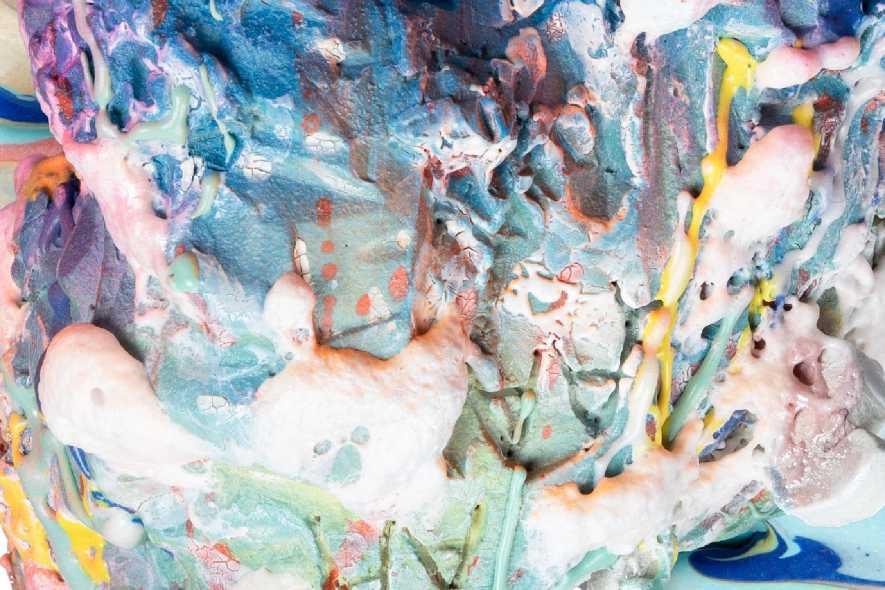
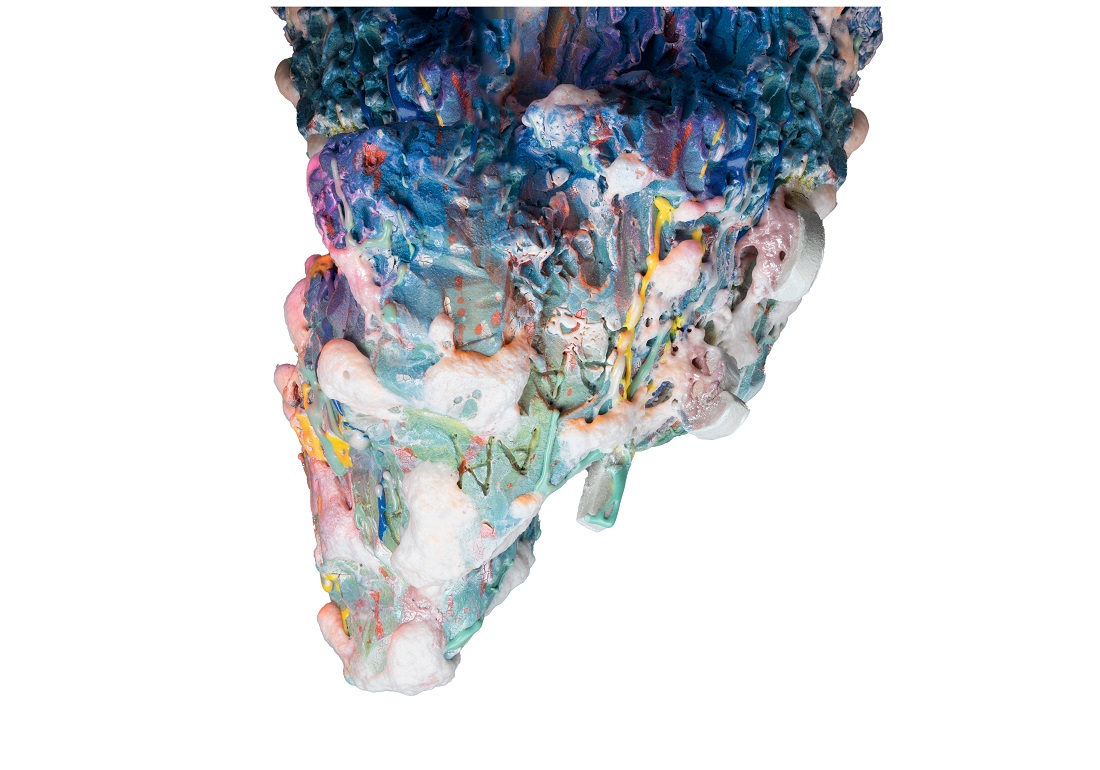
A photo of a colourful up side down ceramic mountain sculpture. The colour from the top of the photo, which is the base of the mountain, is dark blue and graduates down to pinks, purples and pastel blue at the tip. There are also splashes of bright yellow and orange and blobs of dripping white foam.
Kirsty Collins: Upside down mountain

Designing creative space for people with sensory disabilities* and my internalised ableism.

I am one of approximately five hundred people worldwide diagnosed with the autoimmune disease Cogan’s Syndrome after a four-year search. While I was losing my hearing multiple specialists dismissed my symptoms as mental illness. Because it’s rare, there is little ongoing research, so finding medical support is arduous. Cogan’s involves vascular inflammation of the ears, eyes and vestibular system. Over time this results in deafness, vertigo and for some also vision loss.

Chronic illness presents a diminished state of normalness of human perfection. It takes time, but when we embrace our disability, we embrace the innate understanding of being fully human because there is nothing natural about human perfection. I believe our obsession with emulating the norm via our ableism comes from a culture that commodifies everything with promises of perfect health, beauty, popularity and happiness. Personally, this belief system, on top of daily disability social trauma, inevitably makes me fall into the trap of deaf shame, ADHD shame and rare-chronic-disease-shame.

In the Sync program, I was excited to share an online disability arts space and see radical acceptance of disabilities in action.

With hearing and vision loss, the medical industry is our first and often only reference for our ongoing disablement. Though we may need treatment to slow the loss, it’s equally essential to develop radical self-acceptance, purpose and community. For disabled individuals to thrive, we must build disability pride in conjunction with our other pride identities like feminism and find our communities.

“Without community, there is no liberation.“* Lourdes’s proposal of community-in-action is evident in the collaborative community of ceramic production. Everyday shared space, equipment, tools, skills, and machinery are common and celebrated. In the Sync program, I was excited to share an online disability arts space and see radical acceptance of disabilities in action.

Before my deafness, I witnessed social oppression as a child of gay parents who campaigned for women’s rights. I didn’t understand why my two mothers could not marry or be listed as next of kin at hospital or why they missed out on 45 years of wedding anniversaries. I heard them telling themselves that a wedding was unimportant, and the piece of paper didn’t matter; this was how my family internalised homophobia.

At the end of 2017, there was a referendum in Australia on legalising gay marriage. Before my mother died, she was devastated when she saw the mixed results of the 60/40 ‘yes vote’ referendum mapped out in our suburbs. As my mother was dying from Leukaemia, we had to get their permission for marriage rushed through the bureaucratic channels. They had two days in the hospital for palliative care, and she was gone. We counted ourselves as lucky as their marriage ceremony was one of the best moments of our lives.

The insight I gained from this experience was how can we tell the difference between our intrinsic wants and needs and internalised oppression if something has always been prohibited? Seeing the self-protective act of denial in action was revealing, as it showed how we internalise sexism, homophobia, classism, racism, transphobia and ableism.

When my son was a baby, he couldn’t sleep for more than two hours and bashed his head repeatedly. Paediatricians had low expectations, and after five years, he was diagnosed with Autism, RL sleep disorder and later ADHD and dysgraphia. Being a carer for my neurodiverse son taught me that focusing on your “deficits” to normativity is toxic and unproductive (a lot of ABA therapy is now seen as abusive by many Autistic adults). Watching my son, who now plays in a jazz band and is studying engineering, I learned that people with Autism and ADHD are superb specialists and living with a disability is about adaption and innovation.

We habitually conceal disabilities to pass as normative so that we don’t make other people uncomfortable, but this discomfort includes ourselves. When we can no longer pass as normative, our unconscious stigma directs us to withdraw for safety or endure daily disability “outings”. But we can use this to develop disability pride. Only a tiny proportion of people in the world that have a disability identify themselves as disabled due to stigma. And our confirmation bias includes ableist behaviours such as not socialising with other disabled people.

Watching my son, who now plays in a jazz band and is studying engineering, I learned that people with Autism and ADHD are superb specialists and living with a disability is about adaption and innovation.

For myself, the cumulative exhaustion of pandemic ableism caused me to withdraw from my friendship groups after the combined rare-disease medical ableism and daily deaf communication barriers with lip reading and masks. Ableism often comes from the illusion of personal choice. We appear to choose to withdraw from social activities when in fact there may have been a difficulty communicating in crowds and immunosuppressant vulnerability during Covid.

My approach to art it is much like a science experiment. While training in ceramics during my illness, I fell passionately in love with the chemical reactions in ceramic glazing. Now I want to experiment, collaborate with my and other people’s and artists’ experiences of being sensory disabled.

The Sync Program has given me the clarity and strength to move forwards and great tools to understand my decision-making process and the sense of worthiness to ask for help. It has allowed me to think big and see what’s possible—using my technical knowledge in ceramics to build an inclusive, collaborative environment for deaf and blind people—providing social connection through a cultural centre for both ceramics production and contemporary art collaborations as a place for disability creative excellence. I want to show people an example of what they could be capable of after, and during, the hearing and vision loss with community and empowerment.

Kirsty Collins, 2022

*Sensory disabilities refers to blind, deaf and the spectrum of deaf-blindness.

* Lorde, Audre. “The Master’s Tools Will Never Dismantle the Master’s House.” 1984. Sister Outsider: Essays and Speeches. Ed. Berkeley, CA: Crossing Press. 110-114. 2007. Print.

(One of the best speeches ever written!)

Fi Peel: If there’s one thing that I’ve noticed…

Image: Beyond series of waist-high pillars, red concrete stretches towards a large white austere building, tapering at its center into three white spires that rise towards the sky, crested by an Australian flag. This image is viewed through the rear rain-splatted window of a taxi as it passes by on the stretch of road leading towards underground parking and public entry to Parliament House.

Image: Beyond series of waist-high pillars, red concrete stretches towards a large white austere building, tapering at its center into three white spires that rise towards the sky, crested by an Australian flag. This image is viewed through the rear rain-splatted window of a taxi as it passes by on the stretch of road leading towards underground parking and public entry to Parliament House.

The wasted and the loser things, the broken and abused things, all these small things. The treasured and sacred things, the lost and the forsaken things… Small Things The Audreys

I remember when I first encountered the term “impostor syndrome”. I had accepted a role where it was my job to assess the cultural readiness of a community managed organisation as they prepared to embed a peer workforce. A peer worker and mental health advocate, this was the first time I had been recruited to a senior leadership position. In my first week, I was treated like a rock star, which completely shocked me. I was this shiny new thing that everyone was excited about. During one introductory conversation, the senior psychologist on our team, impressed at whatever it was that had just transpired in conversation, looked expectantly at me and asked, “what was the focus of your PhD?”

Embarrassed, I stumbled for half a second and averted my eyes, not wanting to see what might be reflected in his gaze as I delivered my response.

“I’m still trying to complete my undergraduate degree.”

Later that afternoon, I confessed my feelings of being miscast to a colleague on the very small team I had been embedded in. Her response was kind but misguided.

“You’re just struggling with impostor syndrome. We all feel that.”

I had spent the majority of the past 20 years desperately trying to prove on paper what had amounted to almost three degrees worth of accumulated multi-disciplinary academic study. I had almost completely exhausted my government allocated student loan limit. Every time I had come close to subject completion in any given semester, I had ended up in hospital, the legacy of a 15-year battle with chronic suicidal ideation, a lifetime of amassed complex trauma and arising psychosocial disability snapping at my heels. But that I had a head full of knowledge which could not be attested to by any post nominal conferment was only part of the problem.

Arts and leadership had always intertwined throughout my adolescence. A singer first, cultivating a hidden interest in writing before studies in theatre and later voice at university, I had also been involved in student leadership and had dedicated my youth to Girl Guides in my small town on the south coast of NSW. It was almost unavoidable that the confidence I displayed as I mastered the art of crafting my voice would draw the kind of attention that people would look up to in admiration.

I was ridiculed in the school playground, kids vocalising dramatised cadenzas as I passed by, but my music teachers would buoy my confidence and so I persisted. Performing one afternoon at an arts assembly, I left the stage with a sense of crescendo but as the applause began to die down, I could hear the latent booing from students until it was silenced by supervising teacher death stares. I retreated into the wings and fought back tears. As the dance troupe took their places on the stage while the MC tried to redirect the audience’s attention, one of the most popular girls in my year, clad in her black leotard and wispy golden tutu pulled me aside. Julie looked squarely into my widened eyes and whispered fiercely to me:

“You are the bravest person I know. I dance in a troupe, as part of a group where I can hide but you go out there and trust your voice all on your own. Never stop doing what you do. You inspire me.”

These early moments as an emerging artist and young leader collapsed in on themselves in late adolescence not long after my entry into university. My world was suddenly shattered by psychiatric diagnostic criteria and the intervening space of silence was amplified by compound sanist narratives. A life once full of promise was now regarded as futile, less than ordinary, even a source of concern as a shroud of life-limiting narratives were adopted by many, and a deep sense of failure, powerlessness and shame emerged.

“We’re not making any special concessions for you. Even if you are in hospital or dulled down by medications you don’t need due to misdiagnoses no-one will be willing to revisit until you are in your 40s. You are expected to earn your place in this world like everyone else.”

During the first lockdown in 2020, while the world was sleeping, in my own little corner, in my own little world, I dreamed. I wrote. Testing the range of my voice, I began to sing again. The degenerative deafness discovered at 16, had certainly taken a toll, with hearing aids useless to reconcile how I received and created sound. In the silence I determined to rely not on sound, but on resonance. I began to apply for work that aligned with my unarticulated education and aspirations. I began to pitch creative ideas. I didn’t care when rejections dropped into my inbox. I wanted a seat at the table, so I was determined to fashion one unique to my desires for the tables I hoped to pull it up to.

At a storytelling event I was to produce later in that year, our invited guest speaker dropped an Anais Nin quote into his speech that still reverberates through the powerlessness that had pervaded my life for more than 20 years.

“Life shrinks or expands in proportion to one’s courage.”

Deeper wrestling with this truth in relation to lived experience and disability arts leadership led from there into the office of the colleague who introduced me to the concept of impostor syndrome, and further into reflection on what creates limits and silence. In learning to harness this style of tenacity, I continued to find my way to tables that began to repeatedly affirm hope I had dared not believe were possible of exhuming from the rubble. I realised this journey could no longer be dismissed as a fluke, but I still felt unworthy.

In 2022, I was invited to become a contributor to the national mental health reform priorities. I now contribute consumer and lived experienced leadership perspectives in conversations that directly inform parliamentary considerations. I devised and contributed to lived experience-led arts-projects. I became immersed in on-the-job self-taught lessons in disability arts management, holding the line of artistic integrity against unwanted and unbidden external agendas. The journey across the past three years has led to publications, podcasting, acting, singing, editing, producing, directing, project management, advocacy, policy development, supervision, and even consumer academic contributions. The gift of being part of the Sync Australia 2022 cohort was the recognition of tools I already possessed but didn’t know I was allowed to name, claim, or celebrate.

While I had wholeheartedly rejected the notion of impostor syndrome, the soul destroying sanism and ableism accrued from years of being relegated to a mental health system and its wider social narratives that undermined any true hope of recovery was also silencing my ability to accept other’s recognition of what I have always naturally brought to any table I have found myself seated at. And herein lies the intersectional danger of adding the false dichotomy of impostor syndrome to the mix.

The awe and flailing I experienced as my work continued to be recognised as on par with professional actors, writers, theatre-makers, advocates, and leaders in a world still highly governed by “keep up or get out” principles, was a product of not internalized ableism, but rather is due to assumptions of equality over equity. The adaptive nature of our subject matter expertise, our neurodivergence, and our heightened ability to see beyond traditional pathways means that we do pick it up or even work it out for ourselves along the way, which then informs our own unique leadership styles. Cultures that demand productivity over workplace and social cohesion, ultimately silence the inclusivity they would otherwise argue that they champion.

People are still a largely unaware of what it is to navigate the environmental and attitudinal barriers that stand in our way sometimes on a daily or even moment-by-moment basis, to engage fully in our community as disabled and lived experience artists and leaders. If we are going to be serious about the social model of disability in the current Australian sociopolitical landscape, we must desist from activating politically correct practices spruiking statistical representations of diversity and instead focus on dismantling widely adopted cultural myths and outdated theories that continue to silence.

Voices brave enough to highlight discrimination, sometimes even through expressions of distress experienced as threat in the arising frequencies are an opportunity to attune ourselves not to the sound but the resonance.

When is an expression of resistance evidence of an individual failing society and where might it be an invitation to examine further dismantling structural inequity in leadership contexts?

This is a question that hums through my mind and calcifying inner ear bones. I may not have the answers, but I finally understand that the product of sitting with this discomfort has become a calling that I can no longer hide from or push against. I may not hear what others hear but the uniqueness of what I do hear, leads me to pepper my worlds with curious questions. And what I receive in feedback, confirmation and even defensiveness keeps me attentive to the humbling truth that in learning to trust the feeling of the frequencies, we might truly be able find harmonies that modulate dissonance to bliss.

Written on ancestral First Nations lands. I pay my respects to elders past, present and emerging. Sovereignty was never ceded. Always was, always will be Aboriginal land.

Tyson Hopprich: The Spark. The Flame. The Fire. 

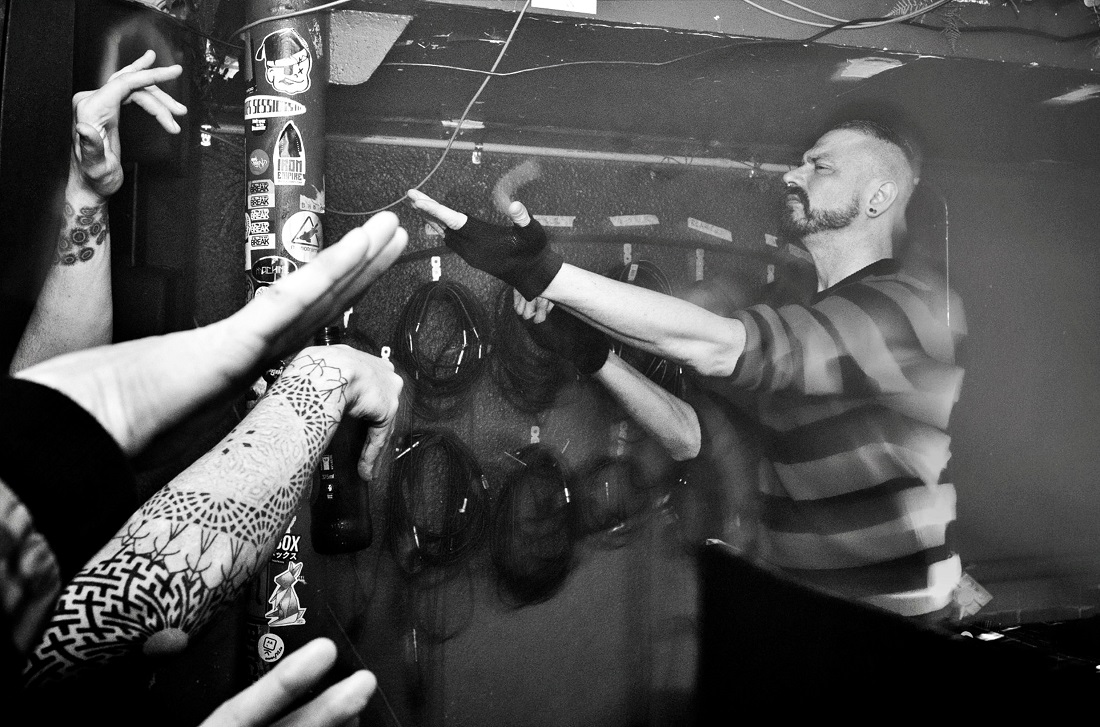
Une photographie en noir et blanc d’un homme dans un haut rayé tourné vers le centre de l’image et tendant les mains vers des bras tatoués agitant au premier plan. Derrière l’homme se trouve un ensemble d’équipements électroniques et d’écouteurs.
a person is seen in a black and white photo taken with flashlight wearing a striped top and fingerless gloves with hands of people visible to the left trying to touch the figure on the right

The Spark.

My disability gave me the ability to find my purpose in life. 

Since a young boy I have always smiled and never complained or felt limited by my disability. However, at birth, I was diagnosed with Talipes Equinovarus (Clubfeet) and at the age of twelve diagnosed with Legg-Calve-Perthes (Perthes) and this disease led to chronic Osteoarthritis in adulthood.

Both ankles fused with no calve muscle development; I looked half-goat, half-man with skinny legs.

My first operation for my Clubfeet was at twelve hours old, freshly Caesarean-sectioned out of the womb onto the chopping block. Each leg is adorned with asymmetrical scars, metal pins and plasters. Both ankles fused with no calve muscle development; I looked half-goat, half-man with skinny legs. I found kindred to the mythical character Pan, a regular guy with goat-like feet who enjoyed music and the company of nymphs. 

This correction and fusion of my ankles occurred in many hospitals locally and interstate. I even stayed in a hospital in Canberra for six months without friends or family. 

Besides having a supportive family, friends and artistic collaborators throughout my life, a big shout goes to my informal guide and mentor Dr Stevenson, a fantastic British Orthopaedic surgeon. Each visit he would kindly say, ‘use your brain, be artistic. These legs aren’t for running or dancing.’ His guidance never created an obstacle to my disability, and my clear limitations made purpose, focus and freedom in my life. My stoicism forced me to pursue my musical purpose of creating a soundtrack for others to move and dance.

The Flame.

My life chapter of Legg-Calve-Perthes Disease and its chronic Osteoarthritis has ended this year with my recent total hip replacement. This surgery has been life-changing as the thirty-two-year chapter of living with pain has ceased. While on the waiting list, I chose to keep a smile similar to my childhood self and create as prolifically as humanly possible in my musical and artistic career, in truth, as a distraction from the constant pain of Osteoarthritis.

I used stoicism as a tool for coping with pain. The famous stoic Marcus Aurelius quote, “Our actions may be impeded… but there can be no impeding our intentions or dispositions. Because we can accommodate and adapt. The mind adapts and converts to its purposes the obstacle to our acting. The impediment to action advances action. What stands in the way becomes the way.”

Post-recovery, I am now pain-free. The lack of consistent gnawing pain has left me more peaceful and open to serving the community with greater clarity. Holding space for people has become easier as my inner self is now calm. This newfound quiet will flow into my coaching style as I support and listen to people, being with them on their terms.

The lack of consistent gnawing pain has left me more peaceful and open to serving the community with greater clarity.

Coinciding with this sea change, I had a profound shift to minimalism. I began to feel the cravings to reclaim physical space and mental bandwidth; in this process, I saw myself selling many things and my identity attached to those items. This process, paired with the want for peace post-op, was of the utmost importance to me. This energy clearing has opened me to new personal and professional growth opportunities.

The Fire.

As I discovered in the recent Sync Leadership experience, I resonated with the mythical Phoenix. This bird of rebirth became my metaphor during our coaching sessions; how I naturally move through different renewal cycles with my body, mind and artistic practice. Over my quarter-of-a-century career in the arts, I have seen myself evolve in this way at least six times, burning up outdated beliefs, practices and identities in pursuing knowledge, stoicism and mastery of my craft further. 

Sync landed in my life at the crux of one of these five-year cycles. I always feel like a work in progress, a wet canvas, an unfinished symphony. By this, I mean that I don’t see my life as complete at any point, outcome independent in many ways. Open to new experiences and learning from the gifts within each cycle. The serendipity of the Sync Leadership program and its learnings and the time to reflect has pivoted me towards my leadership potential, critically invigorating my development to serve better the disability and broader community with greater potency and compassion. 

The Phoenix is now renewed, shedding its old beliefs and limitations, ready to share and coach with empathy and dignity. Thank you, Sync, for this life-changing experience.

Harmonie Downes: Radical acceptance is self-love and the pathway to social change

Une photo de la tête d’une femme regardant directement la caméra avec une superposition semi-transparente d’un iceberg sur son portrait..

I quickly realised that I have been a co-pilot to my own discrimination and this revelation is quite shocking and actually quite sad.

Some two hours after completing Sync and saying our collective ‘goodbyes – but not forgotten,’ a lingering thought prevails. Leadership comes from a place of loving oneself deeply and inviting others in to participate…  is what I wasn’t expecting.

Sync led us through various tasks including leadership styles, approaches, and traits, but for me loving myself in this context makes me feel like I’m stripped bare. It’s raw – and this course makes you sit with these feelings, whether reflections and ponderings, or just the naked truth behind your motivations. You are worth more than you allow yourself to be. 

Sync is about unlocking one’s own process and potential and defining one’s practice, culminating in a personal metaphor symbolising values and process. The program helps participants to identify and sharpen one’s tools, to disrupt and break down internalised ableism and to birth a leadership outcome. 

In terms of uncovering our shadows or limitations, I discovered that I often publicly state I am a person with disability, but I don’t preach it and I certainly have not challenged the status quo enough around me to provide my access needs on my terms. I quickly realised that I have been a co-pilot to my own discrimination and this revelation is quite shocking and actually quite sad. I have denied others to accept me because I haven’t authentically owned my own needs and advocated for them. Wow, just wow. How did I not see the full extent of this until now?

I believe the answer lies in social conditioning and as people with disabilities, we are experts in our own military style self-defence systems, complete with childhood as our training ground. If one hasn’t at least installed a verbal cannon by the onset of school, you could expect the snipers to check in for the stock standard name calling. And if that’s still getting through the force field, then it’s the specialty tools like shock tactics, camouflage and shape shifting just for special effect. The more these tools are used, the more one is forced to blend in through subterfuge because over time, the constant battle of having to fight for one’s own dignity over many years is wearing. However, with more advocates going public about being disabled, the constant exhaustion of emotional labour given freely from many fierce advocates has enabled pockets of light to break through and push for systems of change now that these critical conversations are in the public domain.

Sync Australia is a vehicle for starting these dialogues one person at a time. It’s transformative and it plants the seeds to encourage all of us to openly question each other on what is happening now and what could lie ahead with aspiration and curiosity, the panacea and the zeitgeist. 

These conversations happen in a virtual room and participants dial in from different time zones across the world. Each session is designed to gently dismantle these defence systems and invite you to be your authentic self, to unshackle oneself from the usual normative behaviours, reveal our cultural wounds and share learnings, wins and successes. Small acts of revolution are discovered in moments of kindness. Sync is safe, nourishing and familiar. It beckons you to relax, deeply breathe in and exhale out the stigma and self-deception. 

…as people with disabilities, we are experts in our own military style self-defence systems, complete with childhood as our training ground.

Sync is the perfect program for mid-career creatives to aim and ascend to leadership positions in Australia. There is a distinct lack of disabled representation in public positions and at the helm of arts organisations due to limited or zero opportunities for succession planning and career progression. It’s possibly the product of a background of competition, exclusivity and a long history of disconnection between many of the arts organisations. This is a result of an over stretched arts eco-system being expected to deliver big on small amounts of funding. It’s got to change; the community and disabled arts culture utilises the power of the arts to save lives – why isn’t there more investment for this? My Sync goal is slowly birthing – my vision of wanting to develop my own non-profit was re-ignited again – another surprise.

The door is now open, but where will it lead? We leave the group with the last provocation of “What’s next?” Small gods exist in undiscovered places when we commit to loving ourselves. This affords us the opportunity to develop our skills and tools, to challenge and improve ourselves but to break through our individual constructs and dismantle those of our peers. We then are ready to take a leap of faith and be the change we want to be for ourselves and in the context of a broader, complex cultural landscape. 

You can connect with Harmonie Downes via LinkedIn: https://www.linkedin.com/in/harmonie-downes/

Ice metaphor information:

Why I chose “ice” as a metaphor in the symbol of an iceberg: It is so embedded in our language in terms of what we can see and what we can’t see. The iceberg represents what’s above and what’s below. It is about what, when, why and how we show ourselves. The 20 percent of what’s above, is in the public-facing aspect when delivering an event, performance or creative outcome. Below is the 80 percent that includes all of the tumultuous churning, the thought process, the unseen. Everything that no‑one knows what you have gone through to deliver – it can be resource intensive. What we do ‘back of house’ depends on how we shape our projects. It’s driven by the environment. Can it form; will it disperse? How will we manage to skate on thin ice when things are shifting and shaping? Will the project collapse or will it be delivered? It is a mix of these ingredients to support the sustainability of your work to take form which takes time, careful consideration and problem-solving skills. It can be an incredibly beautiful experience, but painful just as an ice burn can be. It can be refreshing or isolating, but absolutely transformative when it all comes together. Process is key to everything.

Charlotte Jacob-Maguire: Shifting our Purpose

In this photo there are 4 women taking a group photo together. One is holding a sign that says 'for accessible shops' in French

A photo from 2019 of Charlotte (2nd from the right) with an ally and 2 elected officials from the City of Montreal

The core framework of Sync Leadership learning is the 7 Elements and their application in Deaf and disabled leadership.  In a nutshell, the 7 Elements are Choice, Values or Beliefs, Skills or Talents, Passion, Identity, Vision and Purpose.  Developed by the Institute of Human Development, these 7 Elements are a way of understanding self and other’s responses when we spend time online together or in person, through group and 1:1 coaching conversations. 

In a catch-up conversation with recent Sync Quebec alumni, Charlotte Jacob-Maguire our session focused on considering the 7 Elements.  What quickly emerged were Passion, Identity, Vision and Purpose.  We also considered how a life-changing event can alter our life trajectory in a moment.

“I experienced ableism from Day 2 of the stroke

Charlotte Jacob-Maguire

Purpose is what we were born to do. Corny as it might seem, in our lives we usually land upon something that is an overarching driver for our professional lives.

Passion is of course what inspires and delights us.  It is a state that we can recognise in others when they are speaking about something that really matters to them, both good and bad. 

Identity is who we are, the blend of our experiences, but also the useful or not so useful attributes we have or things we believe about ourselves that might help or hinder our progression.  What parts of our identity come to the fore at any one time?  

Vision is the picture we create of where we are going. A little fuzzy at times when life throws curveballs at us, we can work to clarify our vision through coaching, collective sharing and questioning, even in a time of ambiguity and flux.

For Charlotte, having a stroke shifted things in an instant, and pushed her love of museums and collections into new territory. Her identity shifted too, from someone without impairment to a lived experience of disability and these new facets have forced her her to constantly challenge what she believes about herself and her ‘what next?’.

Ableism had previously been more of an abstract concept.  It was certainly one that she challenged, but this change in her own life has shifted her thinking considerably. In our conversation she made a great distinction between accessibility and ableism, as well as describing the necessary shift she has made in her approach to policy and anti-discriminatory practice which she is enacting with a refreshed sense of purpose.

We’ll be sharing more about the 7 Elements in the next few months as we pool the thinking of our Sync Canada 16 with Sync UK 16 – a brilliant handful of leaders who undertook the Sync Leadership programme when it first emerged in the UK, in the lead up to 2012.

This Spring 2021 Alumni from both sides will connect online in an up-coming webinar where we will consider the individual and collective desire to spread the word that Deaf and disabled leadership is more than a notion, it’s alive and kicking!

Watch this video to see Charlotte talking through the 7 elements with Sarah Pickthall:

Maxime D.- Pomerleau: Situational Leadership Shifting

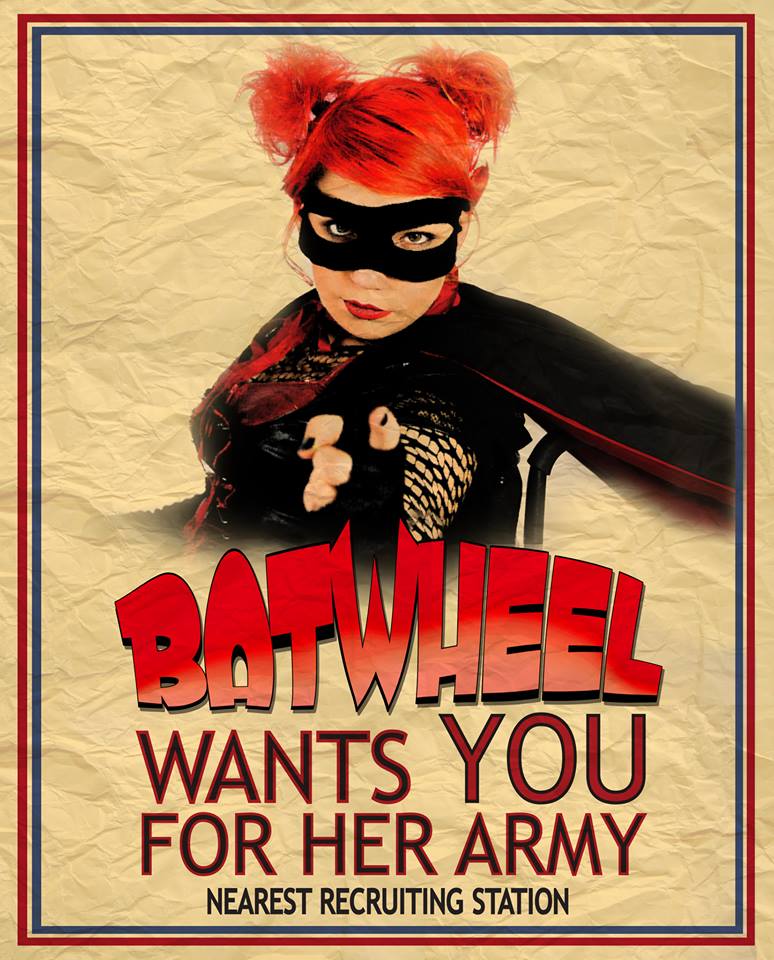
This picture is a poster from Maxime D.- Pomerleau's 2013 short film 'Batwheel'. In the picture Maxime is seated in her wheelchair wearing a black and red superhero costume, pointing at the reader with the words 'Batwheel wants you for her army, nearest recruting station' underneath
A poster from Maxime D.-Pomerleau’s 2013 short film ‘Batwheel’

I was able to meet up with Maxime D.- Pomerleau before the end of 2020 to explore her leadership style thinking. This short film shares her delight in discovering, as part of the Sync Programme in Quebec, that leading doesn’t always mean having to lead from the front.

This realisation has had a transformational impact, relieving Maxime of the pressure to be something that she doesn’t always want or need to be in her professional life.

Too often as Deaf and disabled leaders we feel the need to be out there and visible. Whilst we need to be recognised for our skills and talents, and to fight for the access and flex to do this, this doesn’t have to be achieved through strident flag-waving. We can be different things in different situations, following the ebb and flow of our interests, desires and energy.

It’s true that as Deaf and disabled leaders we often find ourselves to be the only disabled person in the room and having to use that opportunity to draw attention to challenge and be activist. With that comes a sense that our very presence can foist unwanted attention upon us in both good and bad ways. We also have choices to not be those things, to move away from feeling obliged.

Maxime spends much of her professional life in performance and media shape-shifting, taking on different roles whether she is part of someone else’s dance ensemble or driving her own ideas to fruition with or without a team following her lead.  She adapts her leadership as appropriate, responding to situations and needs with flexibility.  Very like her creation, Batwheel!

Batwheel is an additional and delicious case in point: she is the super heroine character that Maxime created some years ago.   The tasked crusader still has a dedicated following online and is currently being refreshed and developed for a new set of potential pandemic quests – a super heroine for crips and a leadership force for change in Quebec and beyond! 

What quests will Maxime explore that will enable her to throw light on the increasing barriers in Deaf and disabled people’s lives through this metaphorical character’s gritty endeavours?

Certainly, with and more and more of the population finding new ways to live with blocks and restrictions, Deaf and disabled leadership needs to throw lived experience of shape shifting into the mix? We have after all been on these survival quest for years. And we may just have the solutions.

Watch this video to see Maxime talking through situational leadership with Sarah Pickthall: