Author: louis

Connor Yuzwenko-Martin: Leading With Your Heart

Connor sits in front of a spiked light glowing white with his head turned upward and arms by his sides. His shadow is cast against the wall behind. He wears a simple blue acid-dyed short sleeve shirt
A photo of Connor from Nextfest 2020 online performance.

On February 9, 2021, around 6 p.m., I was lying on the couch half-asleep and on my third episode of Disenchanted when I suddenly bolted upright, aghast.

A few hours previously, I had walked into my workplace of nearly 11 years and handed in my notice of resignation. It was the end of my full-time job, the end of benefits and discounts and stock options and free lunches. I had given up all of it – during a pandemic – and it was just hitting me. Much like Disenchanted’s Princess Tiabeanie, I was setting out in search of better futures despite the advice of so many to stay with what was comfortable, reliable, and known.

Had I gone mad? Part of me was already thinking about how I could walk this back – “He was in a fugue state, your Honour,” – but a few minutes later my heart stopped pounding and I had reminded myself of all the reasons I’d left. I was fortunate enough to receive some student and arts grants to pay the bills for the next few months, plus have a small freelance contract for communications work, and a few one- off consulting and acting engagements. In just a couple of months I would be starting a practicum to cap off my public relations diploma, after which I’d hopefully secure a job in the arts sector. It was simply time. But why now in particular?

What I had just done was lead with my heart. This had been a long time coming.

So long, in fact, that I can trace it all the way back to the first day of my final year of high school when I stubbornly sat in the vice-principal’s office. That morning, I and my class had realized there was no ASL interpreter booked. At all. For an entire year before I was supposed to start university. I was the sole Deaf student in the mainstream school, but most of my peers cared very much about what this meant for me. I had slowly risen from my classroom seat, taken a notebook and a pen, and walked down to the office where I sat and refused to leave until the vice-principal made specific promises to fix the situation.

That was my first real moment of self-advocacy – my parents didn’t even know until I got home that evening – and also my first run-in with a blunt truth:

Some people simply won’t have your best interests at heart.

This isn’t to imply that my “vice-principals” at Apple – the managers – didn’t care about me. They certainly did, but just as that sweating school administrator had been bound up in the hectic rush of school year prep, so my managers were bound up by the relentless push of corporate-retail work. This seems par for the course in most industries. Even the arts can fall victim to a numbers-driven cycle of cultural input and output.

I believe that managers and administrators should continue to be responsible for everyday accountability. We need that if we want to make any coherent progess as a society. However, I understand now that leaders are and must be different.

Leaders must be responsible for the longer arcs of accountability. They must be the heart-driven custodians of the beliefs and values that shape an environment and influence the amorphous formations of identity, motivation, and even trauma.

Our workplaces and institutions conflate management and leadership far too often. Perhaps there’s no way around the nature of consumerism, seeing how it is so deeply tied to the idea of capitalistic labour where inclusion is only valued for its productive output rather than its intrinsic humanity. Perhaps I’m calling for a revival of the town philosopher as a paid position on the executive board. But is that really such an outrageous suggestion in our information economy where we constantly bring in consultants to make sense of our scattered human movements?

That’s where I come in. The idea of a Deaf consultant is fairly new and still mostly contained to the arts sector where there are many efforts to meaningfully re- engage intersections of experience and marginalization in equitable ways. I believe there is a role for the Deaf consultant in the boardrooms of organizations that are looking toward sustainable ways of doing business: sustainable in the sense of treating each human body and internal world just as preciously as each of the million trees being planted or cubic metres of water being conserved.

We, the ones who so often witness and feel the death of empathy, are exceptionally well-suited to revive it.

I hope that my reflections on leading with the heart have been enough to nudge a few key decision-makers out there to shift gears, or at least inspire a new conversation at the next team meeting.

Charlotte Jacob-Maguire: Shifting our Purpose

In this photo there are 4 women taking a group photo together. One is holding a sign that says 'for accessible shops' in French

A photo from 2019 of Charlotte (2nd from the right) with an ally and 2 elected officials from the City of Montreal

The core framework of Sync Leadership learning is the 7 Elements and their application in Deaf and disabled leadership.  In a nutshell, the 7 Elements are Choice, Values or Beliefs, Skills or Talents, Passion, Identity, Vision and Purpose.  Developed by the Institute of Human Development, these 7 Elements are a way of understanding self and other’s responses when we spend time online together or in person, through group and 1:1 coaching conversations. 

In a catch-up conversation with recent Sync Quebec alumni, Charlotte Jacob-Maguire our session focused on considering the 7 Elements.  What quickly emerged were Passion, Identity, Vision and Purpose.  We also considered how a life-changing event can alter our life trajectory in a moment.

“I experienced ableism from Day 2 of the stroke

Charlotte Jacob-Maguire

Purpose is what we were born to do. Corny as it might seem, in our lives we usually land upon something that is an overarching driver for our professional lives.

Passion is of course what inspires and delights us.  It is a state that we can recognise in others when they are speaking about something that really matters to them, both good and bad. 

Identity is who we are, the blend of our experiences, but also the useful or not so useful attributes we have or things we believe about ourselves that might help or hinder our progression.  What parts of our identity come to the fore at any one time?  

Vision is the picture we create of where we are going. A little fuzzy at times when life throws curveballs at us, we can work to clarify our vision through coaching, collective sharing and questioning, even in a time of ambiguity and flux.

For Charlotte, having a stroke shifted things in an instant, and pushed her love of museums and collections into new territory. Her identity shifted too, from someone without impairment to a lived experience of disability and these new facets have forced her her to constantly challenge what she believes about herself and her ‘what next?’.

Ableism had previously been more of an abstract concept.  It was certainly one that she challenged, but this change in her own life has shifted her thinking considerably. In our conversation she made a great distinction between accessibility and ableism, as well as describing the necessary shift she has made in her approach to policy and anti-discriminatory practice which she is enacting with a refreshed sense of purpose.

We’ll be sharing more about the 7 Elements in the next few months as we pool the thinking of our Sync Canada 16 with Sync UK 16 – a brilliant handful of leaders who undertook the Sync Leadership programme when it first emerged in the UK, in the lead up to 2012.

This Spring 2021 Alumni from both sides will connect online in an up-coming webinar where we will consider the individual and collective desire to spread the word that Deaf and disabled leadership is more than a notion, it’s alive and kicking!

Watch this video to see Charlotte talking through the 7 elements with Sarah Pickthall:

Maxime D.- Pomerleau: Situational Leadership Shifting

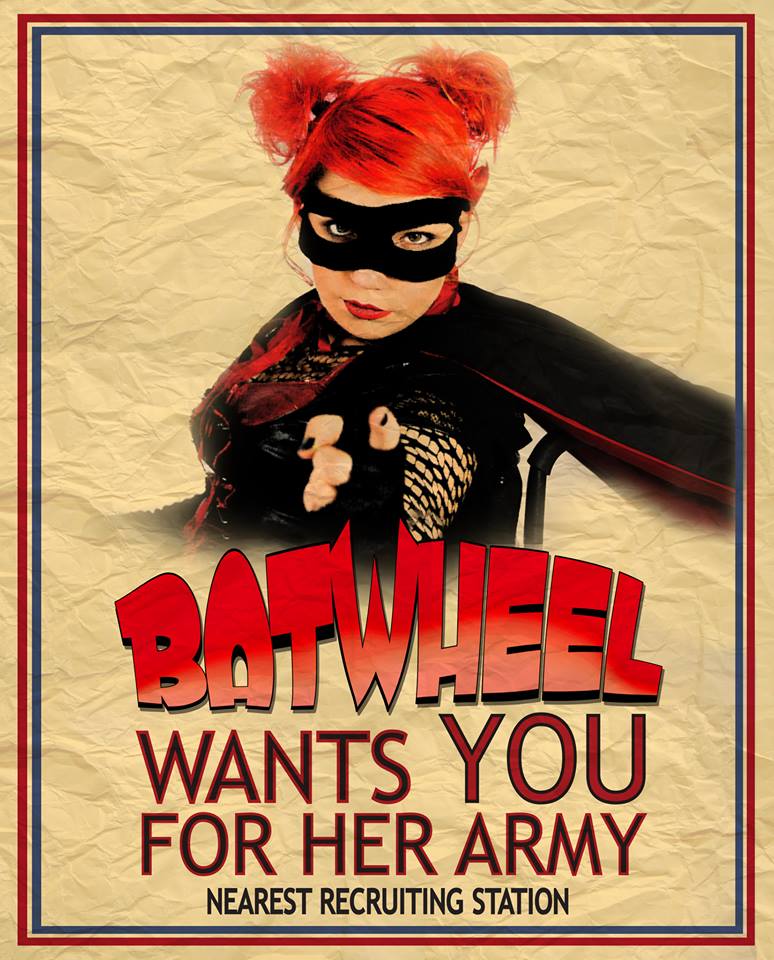
This picture is a poster from Maxime D.- Pomerleau's 2013 short film 'Batwheel'. In the picture Maxime is seated in her wheelchair wearing a black and red superhero costume, pointing at the reader with the words 'Batwheel wants you for her army, nearest recruting station' underneath
A poster from Maxime D.-Pomerleau’s 2013 short film ‘Batwheel’

I was able to meet up with Maxime D.- Pomerleau before the end of 2020 to explore her leadership style thinking. This short film shares her delight in discovering, as part of the Sync Programme in Quebec, that leading doesn’t always mean having to lead from the front.

This realisation has had a transformational impact, relieving Maxime of the pressure to be something that she doesn’t always want or need to be in her professional life.

Too often as Deaf and disabled leaders we feel the need to be out there and visible. Whilst we need to be recognised for our skills and talents, and to fight for the access and flex to do this, this doesn’t have to be achieved through strident flag-waving. We can be different things in different situations, following the ebb and flow of our interests, desires and energy.

It’s true that as Deaf and disabled leaders we often find ourselves to be the only disabled person in the room and having to use that opportunity to draw attention to challenge and be activist. With that comes a sense that our very presence can foist unwanted attention upon us in both good and bad ways. We also have choices to not be those things, to move away from feeling obliged.

Maxime spends much of her professional life in performance and media shape-shifting, taking on different roles whether she is part of someone else’s dance ensemble or driving her own ideas to fruition with or without a team following her lead.  She adapts her leadership as appropriate, responding to situations and needs with flexibility.  Very like her creation, Batwheel!

Batwheel is an additional and delicious case in point: she is the super heroine character that Maxime created some years ago.   The tasked crusader still has a dedicated following online and is currently being refreshed and developed for a new set of potential pandemic quests – a super heroine for crips and a leadership force for change in Quebec and beyond! 

What quests will Maxime explore that will enable her to throw light on the increasing barriers in Deaf and disabled people’s lives through this metaphorical character’s gritty endeavours?

Certainly, with and more and more of the population finding new ways to live with blocks and restrictions, Deaf and disabled leadership needs to throw lived experience of shape shifting into the mix? We have after all been on these survival quest for years. And we may just have the solutions.

Watch this video to see Maxime talking through situational leadership with Sarah Pickthall:

B. Paul Tshuma: Learning to Listen

a picture of B.Paul Tshuma in a wheelchair, wearing a white shirt, wearing glasses

Listening is being able to be changed by the other person.

Alan Alda
B. Paul Tshuma conducts the choir from his chair in a church setting. There is a band playing instruments behind the choir.
B. Paul Tshuma conducting the United Tribulation Choir

B. Paul Tshuma is a published poet, musician, conductor and public speaker and now, a Sync Canada Alumni. Paul shares how Sync Coaching changed his thinking and his practice and shifted his focus onto the people he works with.

As a former Choir Director of United Tribulation Choir, I had a clear vision of how I would want a piece of music to be shaped and sung. As a motivational speaker or accessibility consultant, I similarly wanted to inspire people to make changes in their thinking and practice by sharing my story.

I used to be of the opinion that leadership needed patience, and that for people to change or improve they needed to practice. As part of Sync Leadership, a focus on coaching threw a different light onto how I might view the people I work with in music, motivation and consultancy. I could see how I tried to bring people round to my way of thinking and doing for a fairer more representative, accessible world.

Imposing my view of how things should be in the world, particularly an artistic vision or adjusting mindsets or architectural design for a fairer society, is one way. But it is very much about my story, what I want to see happen, linked to my values, passions and purpose.

Having spoken many times on a motivational podium and having listened to different speakers, I wondered what impact was I having? We often forget that the people sitting right in front of us may need more in order to make change.

Through Sync Coaching 1:1s and in the wider group, I shifted my perspective.  In particular, through the practice of active listening and letting go of my story, I realised that people need to find their own solutions in response to what I am sharing. This was the way that people would be more actively engaged and therefore more motivated to change.

To do this, they needed to find their own story within a shared performance or piece of collaborative work or public address to enable more change to happen for themselves and for others.

Sync Coaching changed my approach to being a better leader, helping me to know myself better through practicing active listening, and asking, or allowing others to ask me, questions.   Dialogue with the groups and teams I work with had to shift from me being the one who knows how it needs to be, to trusting that others have their own solutions. Using skillful questioning is an important part of my work moving forward, leading to pooling solutions to make for better outcomes.

My goal now is to think about the different messages that I want to convey through music, writing and speaking engagements, and to get curious about people’s relationship to the content through posing questions.  Leadership, I understand now, is about being curious about the other: to know more about my audiences, their experiences, their cultural references and what their stories are, and understanding that what I give to them is a chance to rewrite their own stories in relation to mine.

This feels like a completely different approach and one that is exciting. I am motivated to explore this further and am looking into coach training to develop my skills further so I can listen more deeply to people across everything I do.

When all is said and done, my prayer is that I leave those I work with – musicians, architects or audiences – with something that will allow them to create their own stories in response to my own, allowing them to pursue their own God-given journeys to success. As for me, I’m going to work with poetry to continue questioning whatever I can in the world around me.