Carmen Papalia is a nonvisual artist whose performances, public interventions and curatorial projects explain aspects of Disability culture.
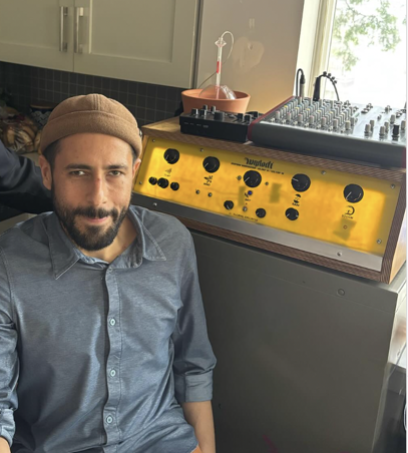
Carmen Papalia is a nonvisual social practice artist whose performances, public interventions and curatorial projects explain aspects of Disability culture such as interdependence, de-medicalization and creative accessibility.
His practice is an effort to enliven his 2015 Open Access manifesto–a set of guidelines that undermines dominant institutional frameworks by approaching accessibility as a “temporary, collectively-held space”. Often emphasizing the possibilities of living on ones own terms, his work is a remedy for the complications of cultural ableism. He joins Sync Re-Ignite as a co-facilitator.
The Weather Warlock is an unusual instrument — not just in how it looks or sounds, but in how it channels power. I think it’s a good metaphor for the way I work to make space for the complexity of disability, culture, and experience — through advocacy, through organizing, and by centering disability within non-disability-led and non-disability-informed contexts.
The Warlock sits between volatile weather systems and those who gather to listen. It tunes into invisible forces — temperature, wind, light/UV index, rain/atmospheric moisture, and barometric pressure — and offers something back in response. It doesn’t translate the weather into something familiar or digestible. It translates it just enough for us to consider it from a new perspective — to want to care for it.
Its range is wide: from soft, grounding, and pleasant to loud, chaotic, and overwhelming. That feels true to the way I hold space in disability culture: being present with grief, joy, contradiction, and emergence — sometimes all at once.
I hold space for unruly, overlapping, sometimes contradictory experiences and offer something shaped by those conditions. I don’t flatten differences or attempt to represent everything. Like the Weather Warlock, I aim to create a space where people can understand what was already present, but in a new way — a space for new understandings they can consider, engage with, and hopefully hold onto. Something they can build a deeper relationship with over time.
The Weather Warlock also requires care. It needs regular check-ins. It needs to be handled gently, responsively. It doesn’t function if you’re not listening. That describes how I approach participation and collaboration — especially because the work I do is for and with the broader disability community. Relationships take time. Trust requires maintenance. Showing up — not just once, but over and over — is part of the practice. I organize by listening closely, caring consistently, and staying accountable to the communities I’m part of.
I live by principles grounded in disability justice and shaped by a worldview I’ve seen articulated through disability art and activism — one that understands disability not as an experience of loss or deficit, but as a way of being and understanding the world. These politics guide how I move: how I pace things, how I build relationships, and how I show up in complex spaces. I work at a pace that’s sustainable for me and the disabled people I work with, often advocating for elastic time — time that stretches to meet the rhythms of our bodies.
That also means addressing hard truths. I don’t soften them to make others comfortable, and I don’t avoid tension for the sake of politeness. That kind of honesty is who I am. It’s how I remain aligned with my own values. I don’t separate my politics from my practice. When I say I don’t make it easier for others, I’m talking about dominant culture — about non-disabled people, non-disability-led systems, and worldviews that fail to see disability expansively. I try to move in ways that reflect what I believe.
What I appreciate about the Weather Warlock is that it has honesty and integrity built into its design. It doesn’t pretend to be something it’s not. It doesn’t smooth out its sounds to make them more listenable. It offers what it receives — raw, unpredictable, specific. Its integrity comes from being fully aligned with the logic it was built on — Quintron’s aesthetic, his needs, his worldview. I approach my work the same way. I don’t compromise what’s complex in order to accommodate dominant systems. I show up in ways that are honest, consistent, and rooted in my own conditions.
The Weather Warlock is what it is. You get what you get. Its sounds are shaped directly by the environment. It doesn’t mask anything or try to conform — and neither do I. The Warlock cannot stop being a Warlock. I cannot stop being a non-visual artist. I cannot stop living in a high-pain body. I work from that place — not despite it. And I organize for spaces where I and others can be ourselves on our own terms, without having to soften or translate who we are to fit dominant expectations.
Each sound the Warlock makes was crafted by Quintron — shaped by his own likes, needs, and aesthetic. There’s a reflection of his identity in the machine, and I respect that. He didn’t build it for mass appeal. He built it honestly. That’s what I value: holding onto our self-knowledge and refusing to let dominant culture undermine it. That’s core to how I organize — protecting the specificity of my experience and making space for others to do the same.
Even the road cases for the Weather Warlock had to be custom-made. There was no off-the-shelf solution — the instrument is too unusual in shape, too specific in its needs. If I wanted to bring it to and from gigs, I had to build something around it. That’s what access and participation looks like. It’s not about “universal” design — it’s about creative, responsive design. The Warlock, like many of us, doesn’t fit into pre-existing molds. And I don’t believe we should be forced to reshape ourselves to fit someone else’s idea of access.
I’m not trying to convince anyone to engage with this instrument. The Weather Warlock isn’t for everyone — and that’s part of the point. It’s there for those who know they need it — who are drawn to its presence, its rhythm, and its refusal to conform.
The people who choose to sit and listen — disabled people, allies, those attuned to access as culture — are often the ones ready to sit with complexity. What they’re sitting with isn’t just sound, but a different way of doing things. A different pace. A different understanding of presence, time, and participation. That kind of listening — patient, open, reciprocal — allows for a more full experience with each other.
Like the Weather Warlock, I don’t flatten what’s difficult in order to be heard. I make space for it. And I invite others into that space not to simplify it, but to live inside it — together.
I hold space for unruly, overlapping, sometimes contradictory experiences and offer something shaped by those conditions.
Carmen Papalia
Other Leaders
-
Salima Punjani
My work is soft and sweet and tender. I would say it is strategically…
-
Dawn-joy Leong
I will always remember SYNC for providing me with the Clement Space — a…
-
Shivanya Ra
As creators, changemakers, and “crippers” of spaces and language, it is imperative to treat…