Belinda Locke and Kristina McMullin

Meeting in person together in Summer 2023 when Sync was in Toronto, Sync Leaders, Belinda Locke and Kristina McMullin reflected on the Sync Twilight a programme they both had trained in and delivered on in Winter 2022 and Spring 2023 online.
I’m Kristina McMullin (to the right in the picture) and my pronouns are she, her, and I’m a white, cis gender, visibly disabled woman, who works in the arts, largely disability arts, alongside academic research and a few other things here and there.
My passion in life is community building and connection. An introvert by nature, I like being challenged by people and my work and the ultimate challenge is community building because it makes me less of an introvert. And I like being less than an introvert! I like to do projects that feed my soul, and make other people feel seen, heard, and desired in community spaces. My mission statement as a human being, is to disrupt systems while being gentle with humans, to tell the truth in a way that is regenerative, to honor imperfect process and to leave room for joy and laughter. And try to do better, always.
That’s why I came to Sync because there’s an alignment of values there. I had met Sarah and Jo in the summer of 2020. It was on the first fully remote Sync coaching in training leadership, which I did from my home in Toronto, where I felt a true sense of alignment in this desire to create community, create spaces, be a disrupter while remaining true to those principles of care and support Sarah so beautifully demonstrates.
Sync Twilight (which brought Kristina and Belinda together) seemed like an obvious next step. I’ve never worked with anyone really outside of Canada and the UK, and I think that it’s great to build these like hyperlocal communities but that disabled folks are always part of the larger global community.
I’m Belinda Locke, pronouns she and her. I live in Melbourne, Australia on the land of the Boon Wurrung people of the Kulin Nation. I’m a white, cisgendered woman. I identify as disabled. I’m a theatre maker and Director, and create multidisciplinary work where I collaborate with people from lots of different art forms. In all of the work that I do, I’m looking to create opportunities for other people to share their work alongside my own. Sometimes I’m curating a festival programmme, or sometimes, like I’m going to be doing next month I’ve got a show opening but I’ve also commissioned other artists to create work on the same theme. I think it’s really important to show different perspectives from people with varied experiences of disability as well as different cultural backgrounds.
I did the Sync leadership programme way back in 2014, and it was so important for me.
I was early on in my career and I was definitely the baby of the group! It really helped to spur me on in a direction where I was able to work with the community in Australia, and Brisbane in particular, to set up a national disability arts festival called Undercover Artist Festival. That was really enriched from my experiences with Sync and from the Sarah Pickthall’s coaching, and the work that I did in person with Jo Verrent.
When I heard about Sync Twilight and this opportunity to co-facilitate a group with you, Kristina, I leapt at the opportunity.
I would say Sync Canada was my first experience of online training. Having that kind of experience and being so supported with such care and flexibility. I loved it,
Kristina McMullin
I would say Sync Canada was my first experience of online training. Having that kind of experience and being so supported with such care and flexibility. I loved it, and have always kind of judged other online development courses against Sync because it was so responsive. It made it possible to tell the truth and be vulnerable. My biggest goal with Sync and with Sarah, has been like, how do I or how do disability identified folks be vulnerable, while still staying safe? Sheryl Sandberg and Brene Brown talk so passionately about the value of being vulnerable, but they’re two women who have oodles and oodles of financial privilege, career privilege, able bodied privilege, white privilege: you know, Sheryl Sandberg isn’t becoming the CFO of Facebook by like, disrupting systems!
Yes, it’s a different position to be in, to our experience. And, you know, when I say our experience there are many different experiences within the disability community, but often, I think you’re viewed as vulnerable to some extent, automatically. And so, the decision to harness that and to find strength in vulnerability is a different kind of process.
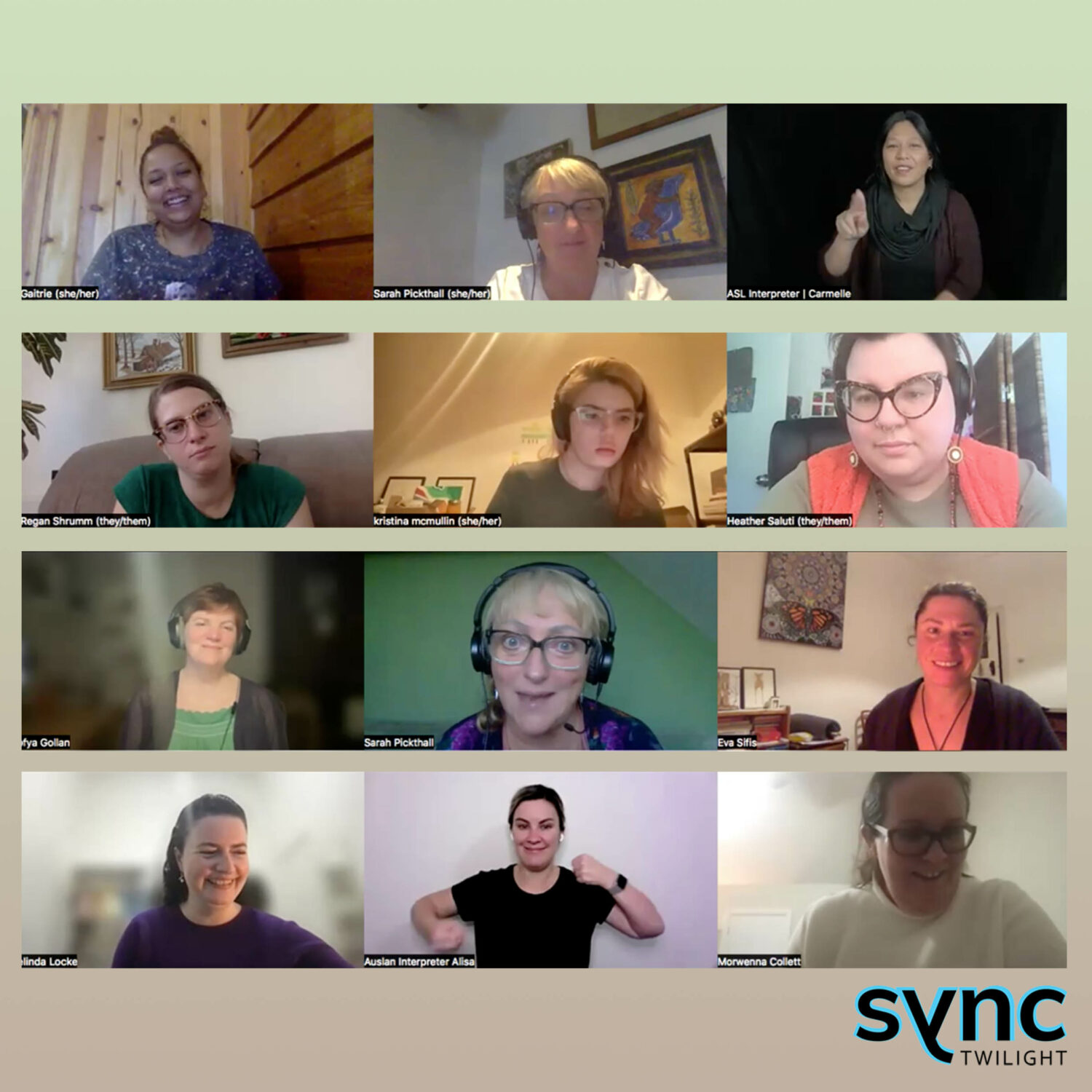
As co-facilitators in Sync Twilight, we both went through this process of facilitating sessions with a small group of people. Disabled folks from Canada and from Australia online. And we did this particular kind of coaching, using action learning. Which, in essence, I would describe as being about one of our peers coming to the meeting with an issue that they’re having in their professional life. Then the rest of the group really probing with questions that are open and not leading, and helping the person themself to find the answer to the issue that they have. So, I’d love to know, Kristina, what you think you learned from going through the process? What did you like about it? What didn’t you like about it
It’s so interesting. I’m someone who doesn’t like seek out advice, but when I do I don’t want to have to self reflect, I just want you to tell me! That was kind of like my immediate reception to like coaching! So I learned through Sync that job of the coach is to empower me to make my own decisions.
I have produced a podcast, so I like to think of myself as someone who can ask good questions. But I ask leading questions: I have an overarching goal. So now, how do I train myself into asking these open-ended questions? How do I make people feel the way that Sarah made me feel even if in the moment, it is a little bit frustrating?! So Sync Twilight was like, a toe in the water and something that I knew was the right next step, to challenge myself so I can be vulnerable, and really build that confidence for this next step of my career.
I think it’s a really generous process to ask open questions that really, you’re not directly inputting experiences that you’ve been through or saying, oh, I’ve been there before. It’slike this whole group is giving their entire focus to that person. And it’s powerful. I saw ideas come to light that maybe the person wouldn’t have come to, on their own sitting mulling over the issue, but with a group of people who are asking things in this really generous kind of way they could find their own answers, and come to perhaps a different answer, but one that’s really fits right for them. I remember, thinking back to Sync Australia initially, how Jo made it really clear that we were all responsible for ensuring access for the whole group and how that turned a switch on in my brain so I definitely became much more aware of other people’s experience and the barriers from their perspective.
Working at Tangled was my first job in disability arts: I’d never like really lived within the disability community up until then. I just was kind of like, over here, I never identified publicly as disabled and then I came into the world with a disability and realised there’s such a need for this kind of work in the arts. It needs to be public. It needs to be more loving. It needs to be more fun; it needs to be more joyful. But yes, as you and I developed in our practice, we realise that that’s not possible to create access for everyone all the time. What is someone’s access need is another person’s distressing environment. So we can aim to be access centred, and I think that’s what I liked so much about Sync. I think the fact that Sync understands the value of access standards and meets and exceeds them in every single meeting and engagement sets such a good example, and means I can do what I want to do which is build community and challenge myself and support my friends.
So, I think my key takeaway from Sync Twilight is that the knowledge is in us, and can come to light through the effort of others. And you can feel at ease in the process, to chill – that’s what I learnt from you!
So often I can like perform authenticity or I can perform vulnerability. And I think with Sync I don’t feel that pressure. So that feels nice to hear that like that comes across, that true authenticity and vulnerability where it isn’t a performance, and there is inherent value to that. I think my key takeaway is that you can redirect someone deliberately, in a careful way, full of care, and that redirection doesn’t need to be a critique. It can just be an offering.
One of the most important things about these Sync spaces is their difference in allowing that authenticity.
Belinda Locke
Yes! One of the most important things about these Sync spaces is their difference in allowing that authenticity. Right or wrong, a lot of the time in my life I’m kind of keeping up a bit of a façade you know, because the structures and attitudes in the world out there mean that I can’t be how I am in my body in a way that’s comfortable for me and stay within a social standard. In Sync it allowed me to give myself permission to come along and be like, hey, if I tell people I’m going to need to sit on the floor for a bit or turn my camera off for a bit, its fine. That even there’s no need for explanation, we get it. And isn’t that liberating?
And I love how the structure enabled us to be interchangeable in that kind of role, how we shared the leadership and support. There was I think something really beautiful about being able to use our lived experience in a way that’s not about advice giving and so it wasn’t like having to be in this mentorship role but we were still supporting other people’s growth.
Yeah – I think what I learned the most from Sync Twilight is that like we as human beings can fill multiple roles. if everyone’s needs are being taken care of and the overarching intention is there, so our skills, our expertise, our interests can be malleable, depending on capacity and needs for that day for us and the desire, capacity and needs of the group. And that’s so liberating!