Sync Shorelines was a part of Sync Summer Sessions in Canada, hosted at Tangled Arts+ Disability in Toronto and was a small gathering of blind and low vision Sync leaders and associates working with podcast producer Yousef Kadoura of Crip Times podcast acclaim.
Sync Shorelines was an important first step in sharing these leader’s vital points of view as generative, powerful perspectives for all. The word ‘shorelines’ is understood to be a physical element that a person who is blind or has low vision can use as a directional aid.
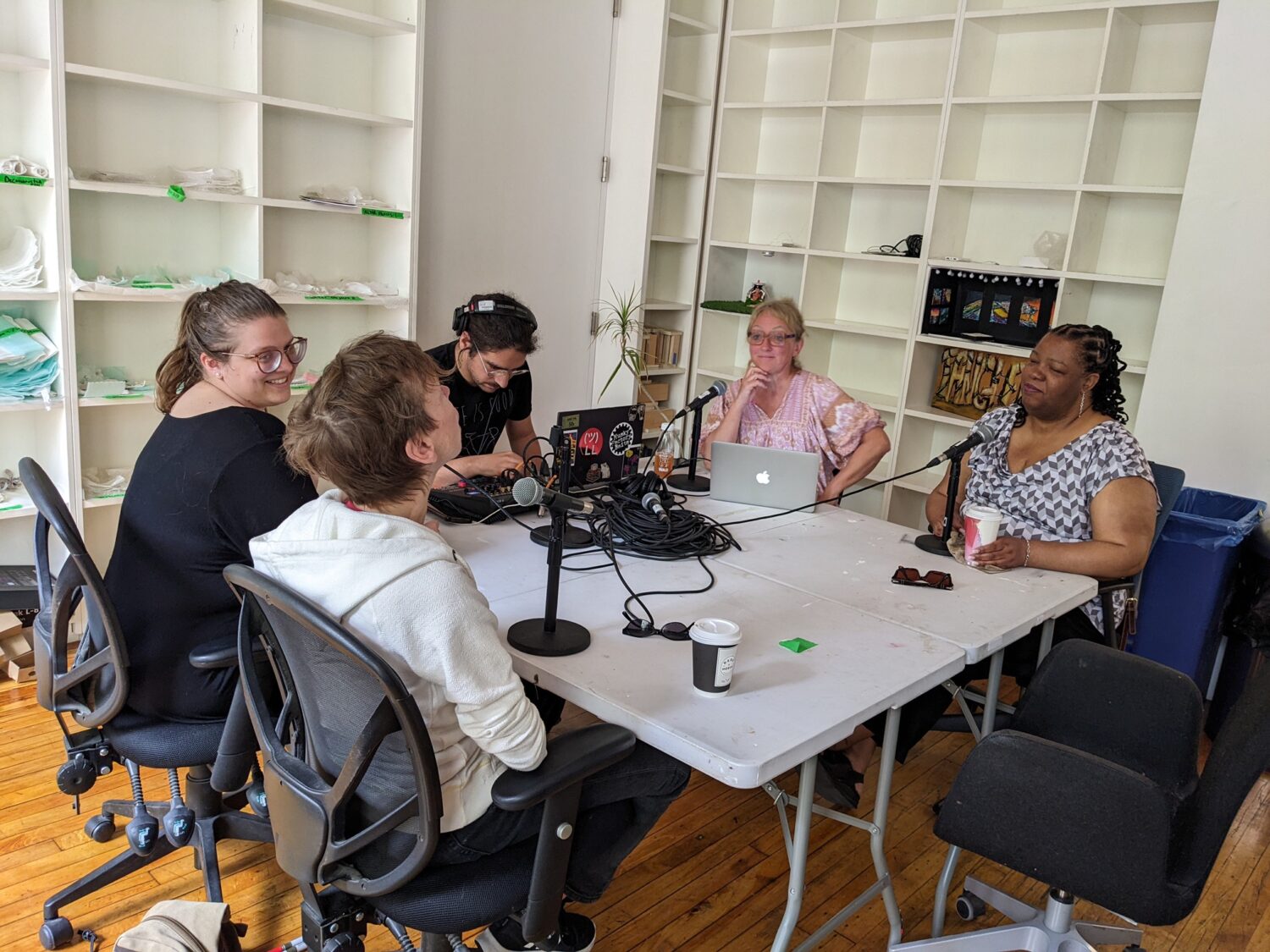
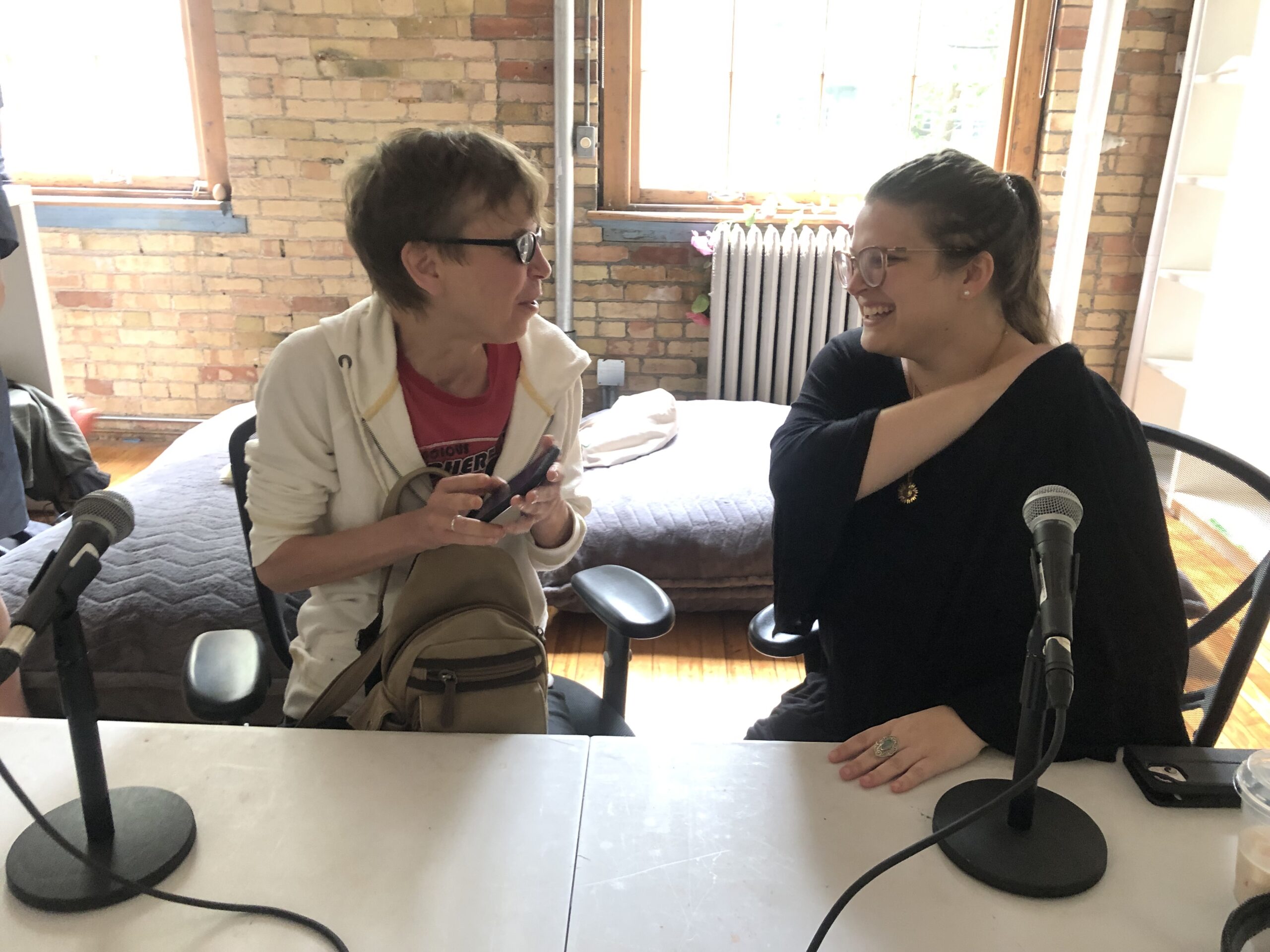
Working with Alex Bulmer and Ingrid Palmer from Sync Ontario, 2020 and joined by Dr Jess Watkin. The podcast touches on facets of blind and low vision leadership including the place of fear in leadership and the natural solutions in performance co-inciding with the premiere of Alex’s new play ‘Perceptual Archaelology, (or how to travel blind) at Crows Theatre, Toronto, Summer 2023.
As artists and leaders who are Blind or have low vision, how does our way of moving and travelling inform our artistic practice, our leadership and our sense of belonging to community. Is a “shoreline” or boundary a limitation or a new direction? Does how we move have any impact on how we communicate, lead, create or think?
Alex Bulmer
Podcast Sync Shorelines produced by Yousef Kadoura
Listen to the podcast
Read the transcript
Transcript
Sync is a disabled-led leadership and coaching programme working globally with deaf, disabled and neurodivergent arts and culture leaders.
I’m Sarah Pickthall, and I co-founded Sync alongside Jo Verrent in 2008. We both experienced the need to break through the glass ceilings of discrimination and opportunity and lead the way in our cultural lives.
15 years on, we’re still shaping our own futures and those of others. In 2020, with the support of David Bobier of Vibra Fusion Lab and Canada Council for the Arts, we secured development resources to roll out Sync in Canada.
The pandemic meant we had to do this online. So since then, we have run three online intensive courses and staged international coaching exchanges with Sync in the UK, Sync in Australia, and some creative exploratives too.
So, fast forward to June 2023: I’m here live in person in Canada, helming a series of face-to-face Sync summer sessions with brilliant Sync folk and other esteemed guests.
Today we’re at Tangled Art plus Disability in Toronto.
Thank you, Tangled, for hosting us. And we’ll be working alongside the brilliant Yousef Kadoura. And in this podcast, we’re unpacking blind and low vision leadership with guests Alex Bulmer, Ingrid Palmer from Sync, Ontario, and we’re delighted also to be joined by Dr. Jess Watkin: welcome to Sync Shorelines! We’re then going to share this podcast and stage further online conversation with other blind, low vision sync leaders in Canada, Jordan, Palestine, UK and beyond in the next few months. We’re also going to be talking about Alex’s new show. It’s called Perceptual Archaeology: How to travel blind. And it’s a co-production between Fire and Rescue Team and Crows Theatre.
Welcome, esteemed podcasting folks. So, introductions. Alex, can I start with you?
Yes. Hi, I’m Alex Bulmer. I’m an actor, writer, theater maker, an educator, I guess. I’ve been at this for over 30 years, and I’m very, very delighted to be here with you today, all of you.
Ingrid. Hi. My name is Ingrid Palmer. I am an author, speaker, sometimes poet, dreamer, all of the above. Lovely to have you with us
Jess hi, I’m Jess Watkin. I am an artist scholar. I finished my PhD last year specifically researching disabled artists and how they make theater and how they’re supported in the way that they make theater. I’m a tactile artist, so I do lots of touch related art. I’m a dramaturg specifically focusing on disability politics and blind dramaturgy. And I’m really happy to be here.
So welcome, all. We decided to call this gathering and frame it Sync Shorelines. Alex, you coined that phrase. What was the thinking behind that?
(Alex) Yeah, I suppose I’ve been recently very inspired by the notion of travel and movement through space. It’s been sort of the focus of both of the shows that I’ve created in the last five years, and I am really fascinated by how movement informs the way that we communicate, the way that we think, the way that we belong in the world.
And as a blind person who has moved through the world using both a guide dog and a cane, I became very interested in how both of these create a very, very different sense of relationship to space and in the case of being a cane user, I use my cane to identify what are called shorelines, which are basically the sort of the parameters of the space that we’re walking through. So the boundaries – you use those boundaries to give you directions and we think of boundaries often as some walls or barriers but in actual fact for when you’re using your cane those boundaries are actually what give you directions through space. As a guide dog user shorelines are actually what the dog is moving you between, so you become a person who is moving in a space that I would refer to as an in-between space or a gap. I’m very interested in gaps, and how gaps inform leadership, so that’s why I like the idea of calling this Sync Shorelines
So like Sync is about the mesh between coaching and leadership. Sync is about coaching and leadership. A question for you all well, what does it take to lead being blind or having low vision? Ingrid?
(Ingrid) It takes boldness to lead blind. It’s being willing to go into the unknown, to the dark spaces and leap. Take a chance. It definitely takes being able to connect in different ways from what the norm is. And so not being visual and not having the ability to read someone else’s face, or to read their body language, and to take notes from that on how to proceed in you know, building a relationship or a connection as a blind leader, it really takes making strong use of your other senses. Active listening is incredibly important, listening to the words that are used, how they’re used, what’s stressed what isn’t, you know, noticing where there’s tension, what has been left unsaid, and taking all that information in order to use that to build a relationship with someone.
(Jess) It’s interesting for me to really think about blindness in relation to leadership because I feel like for me, it’s always been a bit of a natural progression of being this, I’ve been only been blind for the past 15 years. But it feels like you know, I started graduate school I started teaching as a blind person. So, I’ve never known it as a sighted person, and having students ask me questions. I was teaching an acting class and having students be like, how can you mark my face if you can’t see it? And I said, Watch me! That’s a me problem, not a you problem. And I figured it out. I won’t go into that now, but I feel like it’s just been one of those things that for me, vulnerability has really led me.
I currently started a new job at the Stratford Festival here in Canada. It’s the largest Repertory Theatre Festival in Canada. And my colleague said to me, reflected back to me, he said, you deal with your blindness, the way that you consider who you are and your identity as a blind person with reverence; I’d never been offered that before. That I had been so reverent in the way that I steward disability inside spaces. And I think I would offer that as a part of my vulnerability, that I, you know, in order to open up a space I go, hi, I’m Jess and I can’t see and this is what I need from you in order for us to be here together. And I find that for me, that vulnerability comes out as an invitation for other folks who I’m encountering to open up and turn towards me and see me – pun intended or not. And I think that, for me, it’s really been a labour of understanding where that vulnerability serves me, and where I’m manipulating it to try and get something you know? Because I’m a leader and I’m like, ah, if I’m vulnerable here, other people will be vulnerable and so, for me, it’s been a real tug and pull, a learning labour of love of really understanding where that vulnerability can be used in a really beautiful way in relationship to other people.
And so that’s been big for me and in similar ways to Ingrid like, the practicality of being a leader who is blind – the expectations around looking towards the leader in the room. Again, going back to teaching safety stuff: if I’m teaching an acting class, or if I’m teaching students in general, there’s an expectation that the teacher is going to be able to deal with anything that comes up and I have to really invite a vulnerability and an interdependence in my classrooms and in the spaces that I hold. I think, through that work as the leader, it allows people to learn in a different way and encounter my blindness and disability in a different way. And I found it’s really beautiful to watch people learn through those moments. So, I find vulnerabilities a big part of my blind leadership journey.
Thank you. Alex?
(Alex) Yeah, I mean, I have to say the word that first came into my mind was vulnerability as well. And I think Jess has really captured it. And so, I guess the other thing I may add is something around time – and again, I guess this comes back to this idea of a gap. I think one of the things that I’ve learned over the years is that it takes time to gather information, to gather an understanding of let’s say, who’s in the room if we’re talking about a creative space, or even if we’re just talking about coming up with an idea to take forward?
I feel that I need to give myself permission to take the time that I need in order to really understand the complexity of the community and maybe have conversations that will inform me to then take that, that step forward. And I think the time needed to make those decisions about moving forward, and also to give myself the time to embrace whatever that step forward may be, whatever the impact that it has. And you know, there are successes and failures.. or I’ve never really been comfortable with the word failure but successes and not successes I will say, and also taking the time to learn from them. So, there’s something about time and giving yourself time to rest and giving yourself time to celebrate.
Thank you. I’m just really interested in something we’ve be spoken about, connection.
Connection – what is it for you and how you create connection, as you lead in whatever spaces you inhabit – performative spaces or instructional teaching spaces. How is that for you? And also that sense of connection but also control. And your need to know more about what’s going on, or your need to have things relayed on your terms more, just so that you get more context so that you can do the things that you’re setting out to do.
(Ingrid) For me, especially when I am on stage and engaging with the audience it’s really important for me to keep that connection between ourselves like really tight and real and tangible. So, I like to bring noisemakers, I’ll bring little horns or little coppers. And I’ll hand them out to the audience and I’ll say, you know, when I’m speaking you know – as I speak, and as I share vulnerability – (make a noise!) because as we spoke about with vulnerability, how when you’re opening yourself up in a vulnerable way that also invites people and gives permission like, oh, I can be vulnerable too. I can share too. Because we’re so used to hiding our vulnerability out of fear of being judged so when we start out by opening ourselves up, then that just invites that in, that initial connection. And then for me, being able to hear the audience is super important. And so, I always invite whooping, hollering using those noisemakers, snapping even as a way to let me know that, you know, we’re resonating. We’re in tune. You know, you’re here with me. Because my relationship with silences is really tricky.
In the past, I’ve interpreted songs as I’ve envisioned, oh, everyone’s falling asleep, therefore, and maybe they’ve even left and I’m just here speaking to myself. And so, it’s really important for me to use noise, use sound, as a connection to know that we’re still journeying together here, that I’m not by myself, that I haven’t lost anyone. And so, I’m inviting people to make noise even while I’m speaking into it. You know, encourage that! You’re not detracting from what I’m saying – you’re actually adding to it – we’re in this experience together. And you know, this isn’t just about you sitting here watching and listening to me, but about us, communicating back and forth together, whether it’s words or sounds, so I love having that relationship that way. And I feel like it’s also a real relief to audiences, who so often, I think, feel that their role is to be quiet and to not engage so to actively invite them to engage with you while you are sharing. I think really forms a really good bond, that kind of just releases any tension about how you can interact with one another and what’s respectful.
I find that around disability people are always really nervous about what they can do or can’t do or say or, or can’t say, and just being able to relieve that tension and say, just interact, just engage with me. It’s okay. We’ll you know, we’ll work everything out. We’ll communicate and understand each other through that.
Alex – can you talk about connection in the performance work that you’re doing in Perceptual Archaeology?
(Alex) I mean, what Ingrid just said is spot on and, in Perceptual Archaeology, I use applause a lot of the time to give myself orientation in the space which is also a really fun thing to do, because a plus is also considered when you ask for it.
Very cheeky because it’s about yay, they love me! Oh, there you are audience. I’ve got my back to you so I’ll just turn around. I mean, it’s a really, I absolutely love doing that. And it is very cheeky, and also using this notion of ‘boo’ ‘yay’, which again, is both a theatrical way of saying boo, you know, I don’t like the show, or yay, I love the show. But I also use it as a form of orientation to the space so I think I like having fun with those things and theatricalising my access needs is something that I just find really exciting and joyful about the work.
And I think what Ingrid is saying too, about you know, inviting the audience to snap your fingers or this idea of you know, breaking this, this idea that audiences are meant to be quiet, you know, listen to your every word, I think. I think that’s a great way to also melt that sense of, “oh, I must show reverent respect for the disabled person on stage” and it really makes me think, too, about the challenge of comedy. You know, there’s a lot of humour in perceptual archaeology. And the couple of times that I’ve used humour in a show that centers on disability – I remember doing assisted suicide the musical with Liz Carr – and the challenge of humor for audiences who haven’t really exposed themselves to a story about disability before. Like some audiences just do not think they’re allowed to laugh, or you get the opposite: they laugh at like, all sorts of things (and) you can just tell they’re just so nervous. So yeah, I think bringing comedy in front of an audience that isn’t familiar with disability in theater – you just, you do not know whether or not it’s going to connect but I love using comedy because I think it really disrupts that sense of, you know, the delicacy of being disabled, and it dissipates fear.
And I wanted to ask you about fear in blind and low vision leadership as well. The role of it, because of the techniques that you’re describing both Ingrid in your performance and speaking work and Alex and this extraordinary new work, it sort of makes people feel less fearful, but what is the role of fear in your leadership? Is it something that you have to manage and quash and work with in quite a difficult way? Or is it something that you use to harness other things to give you energy or insight? Tell me about fear.
(Ingrid) I’ve definitely had to change my relationship with fear over the years. Previously, fear was something that controlled me and contained me under the guise of safety – but there was a really fine line there that kept me from, you know, trying new things and putting myself out there because what if something happens? What if you’re not successful, or what if it’s not received well? And then there was also this duality because I live my life in fear, and I go outside. I don’t, you know, I have to push through fear to go, to go about my life to do things because, you know, I don’t see things the way that other people do. And so I have to always be moving through the space of not really knowing. And so, having to do that, and I think over the years of having, changing my relationship with fear, in terms of like, fear is something that signifies danger. And scary, as you know, (but) I’m realizing that when I’m excited, it actually feels the same. I have the same butterflies. I have. My heart is quickening. So maybe it isn’t a danger signal, maybe it’s excitement that’s actually meant to push me forward and not to hold me back. And so, you know, being able to change that perception of that. I just need to be aware of that perhaps and it doesn’t necessarily mean stop. But it can also mean to go. It’s really helped me to be bold, to bring my imaginings to reality, and to stop just focusing on negativity and what could possibly go wrong because there’s so much that can also go right. And I think being able to welcome fear and to hold it even closer instead of pushing it back, to be able to leap at the same time is why it’s important, so I don’t try to get rid of fear anymore, not to see fear as my enemy but to actually embrace fear and to recognize that fear is not necessarily a negative or a stop sign, that it can actually be an energy – as you said – to harness and to fuel your actions and it can be “oh my god, let’s do this!”
Thank you. Yes, I mean, Alex – from the show a line that just has resonated with me – is “fear keeping me safe, or keeping me stuck” Where is fear for you, how do you work with fear?
(Alex) Yeah, I find it extremely useful. But I’ve had to learn how to negotiate with my fear. And, in a sense, make a kind of an agreement with it in terms of okay, how much fear do I need in order to do this task, even if it’s as simple as walking to the shops on my local Parliament Street? Because there’s danger. There are cars. There are people who often grab me, call out to me. And if you don’t negotiate with fear then you are always, or I will always be, shocked and possibly disappointed – or put into a position of never wanting to go out again. If I use fear, almost like a little something in my back pocket, you know, not my full clothing you know, it’s not covering my whole body. It’s not all my clothes, it’s in my back pocket!
And it is there and I think about it and it can pull it out. And it is there to protect me because I can think of fear as yeah, as a form of protection. It prepares me and if I don’t need it, then it’s in my back pocket, it’s not in my front pockets, it’s in my back pocket. So, it doesn’t prevent me but it prepares me, and I just think it’s something that as a blind person I have to negotiate every day. But it has taken a long time for me to understand that I don’t want it to keep me stuck. And I don’t also want it to keep me completely safe! There’s something in between. And I think having it in my back pocket enables me to become more competent, more forward moving, it keeps me having a future.
It’s great. Also, I think in the Q&A yesterday at Crows Theater, one of your previews, you shared with the audience, the decision you’ve made to have a line reader, to have Enzo reading your lines. And we were talking about that afterwards and the fear of forgetting lines. You just didn’t want to be in that space of having to think about remembering all the lines; in a show of an hour and a half in length, you’re the key protagonist in that, holding that, and having made a decision I’m not going to feel fearful about that. So, I’m going to make a decision and build this into the way that the play works – and it worked so well. Can you say a little bit about that?
(Alex) Yeah, I just knew that I would have a level of anxiety that I couldn’t cope with if I had to know all those lines, and orient myself in the space you know, and also embrace the disconnect with the audience, which is bound to happen and it happens a number of times throughout the show where I suddenly don’t know where I am and where the audience is. And I just can’t, and why should I? Why do I need to put myself through that? Even though that is one of those sorts of supposed expectations of being a performer that you know your lines, it’s like well, not gonna! I don’t want to! And taking that off my plate was a huge relief like – I have so much fun. I feel so free not having to remember my lines.
I’ve had to learn how to connect with the text. You know, it’s not like I’m not performing the text I am, and it’s delivered to me in my ear in a very neutral way. It’s not – he’s not performing it in my ear, he’s reading. He’s just reading my lines the way that, you know, you would have a script in front of you. But then it just becomes this fabulous interdependence between me and the line feeder which is so much about my life as a blind person like it just, it is so much about the show. Interdependence is so much about the show. And listening is so much about the show. So, it just makes so much sense. But yeah, it came from fear – and what a great thing!
Jess, can you talk more about interdependence in the show within your role as disability dramaturg?
(Jess) Yeah, I feel like, it’s so interesting because when you know, like I’m very familiar with interdependence as a concept which for the sake of this, I can maybe briefly sum up which is there’s this pervading kind of colonial, patriarchal, racist idea around independence that we all are going to like, grow up, be adults and do this whole life thing on our own. And then there’s these wonderful disabled folks who are like, hey, nobody does anything alone! And it’s a farce, it’s completely a lie that we do anything really independently. But it’s been incredible. Disabled folks who’ve really developed this idea that we can be stronger if we rely on one another, like why not? And so, watching, I mean, through this process, we’ve had a few creative enablers, or line feeders, who’ve come in and out with working with Alex and watching someone learn how to provide that neutral line feeding, how to support Alex, how to anticipate her needs: it’s been really a beautiful lesson in interdependence. Just watching the process. And this is something I think about a lot in terms of disability performance and disability arts – that a lot of the care and interdependence is actually not always obviously a part of the artistic experience. A lot of it is embedded within the frameworks and the relationships of the show. So, for example, you were just talking, Alex, about, you know, how Enzo delivers your lines neutrally. The audience doesn’t know that, right? And so, it’s really these intimate moments between you two that so like, in preview one I think, or maybe it was a dress rehearsal, I was sitting right beside Enzo so I could hear his line feed, what he was saying to Alex. I could hear it as a blind person. I got sonic hearing, and it was the first time I’d heard him and I hope you don’t mind me sharing this Alex, I think you say it in the show. He was describing where Alex was in relation to the space as well as line feeding into her line feeding mic. So he was saying, line line line line line line, okay Alex you’ re close to the sofa turn a little bit to the right, okay, yep, you got it, line line line line line. And I never heard that before. And I started to cry. It was the most beautiful moment. I honestly I thought to myself I’m gonna write about this because it’s just this I was like, this is where you should watch the show! Because Enzo, line feeder becomes another character for me. He becomes this interdependence of him going and he’s so like, you did it. Okay, great line line line, line. You know, it’s this implicit support and love and care that he has, and also knowing that your relationship has just been developing and so it’s, for me, a really palpable idea of interdependence that is kind of a secret in the show. We’re all curious about it, exactly. So curious about it.
Ingrid and I were talking about it yesterday, but that beautiful moment where you hand over to Enzo and say look, I’m tired, I need to rest and you take over Enzo and then suddenly you take it back. That’s enough. You know, and we’re talking about how rarely that happens. So, if you hand over and that’s it, you’re done. You’ve had your moment and you can’t ask for it back. And to see that on stage was just it was so remarkable, talk about the sort of tears welling, something shifting inside you to see that as part of the performance was wonderful.
It was beautiful for me listening and hearing that and also, it was just the modelling of it. For others who still don’t understand that concept of interdependence, and also that it doesn’t just apply to persons with disabilities, like as you were saying, just that none of us do anything alone you know, this independence thing and like you said, it’s a complete farce, but the modelling of it and the modelling in the way to did it like I’m onside with you and there’s what’s the word? There’s no hierarchy there, right? That’s what we want to see. That’s how it should be. It was just beautiful. Like my, my heart! I didn’t see it – I heard it. I felt it. And it was just, YES! This is what independence is. And the dignity within that that’s maintained. Alex’s dignity was never injured, and that’s what we want to see. And that’s the reality sometimes out there in the big world, for disabled people where we are not afforded the same rights as everyone else. You know, if we express fatigue, you know, it’s a sign of you can’t handle it… Oh, yeah, lord. We’re all fatigued at some time. Like, let me take over for a bit and let me just support you for a bit, you know, whenever we express our need, it’s somehow reinterpreted as oh, gosh, I guess you just can’t do it. I guess you just can’t handle it. Which is not the truth and not the reality of anybody. But there’s so much that in our lives as persons with disabilities that we are not allowed to have, and to express – to briefly relinquish and then take back – and then to see it so exquisitely modelled for everyone in the play and the relationship between Alex and Enzo yesterday was just beautiful.
Alex is smiling!
(Alex) It is I mean, we had a talk back yesterday, which you were at, and when Enzo made the comment that we just kept trying to make each other laugh? Oh, I just loved it when he said that because I thought, wow, it’s true! And that’s to do with two people. Right? Two artists. With huge respect for each other. And that’s it. That’s all we tried to make each other laugh and I just thought that isn’t me like he didn’t say, you know, I was really conscious of Alex’s safety and working with a blind lady. I just I felt so honored. We tried to make each other laugh and I thought that he couldn’t have said a better thing like that. Just said it all to me that we tried to make each other laugh. And he also talked about getting in rhythm. You know, finding a rhythm together, which I thought was wonderful. And you know that really was so moving once we had that rhythm, and it really takes time because he’s got to listen to every shift, every pause, you know, because it’s live so it’s different every night. And I have to also really get in tune with his vocality is if it’s my voice in my head. You know, it’s truly a remarkable thing when it finally becomes like my voice in my own head. And I become, in a sense for him, his way of breathing. So, it’s really quite extraordinary. Because he has to breathe with me. That’s kind of what it is – the rhythm of breath.
(Jess) And that’s a big part of the show, too. I mean, we’ve talked about that a lot, where there’s lots of moments where you’re connecting to your breath in the show, and how that grounds you within your body. And that’s something that we talked a lot about in terms of travel and in terms of how we find place is breath, so it doesn’t surprise me that you and Enzo line feed and find that really grounding throughout the show- that the breath is another grounding heartbeat for both of you to connect, both to one another through a tiny little headset. You know, like that’s incredible
So, so we’ve talked about vulnerability, and fear and interdependence as part of the things that are harnessed within blind leadership. And leadership so often that, context is blindness, blind spots in leadership, theory and practice are negatives, but all I can hear and feel and experience together is this: the positives within this, and how we’re harnessing these things to great effect. I can only feel the positives and potential for leading in leadership. For others also, maybe send final thoughts on what our lived experiences can offer arts and culture moving forward. Alex?
(Alex) I just think maybe call the blind spots your closet, right? Like, go into your closet, all the things you have felt, you have to hide. They are your gold, that is your power. So, if you need someone to line feed for you in order to be in a rehearsal with a new script, or any script -doesn’t matter, like when I did R and J, I had to have a line feeder. It’s like, oh, right, that that person is supposedly, you know, over in the corner and hidden, put them right out, put all that stuff that one may think should be in the closet or should be in the corner -pull that out and put that front and center. That’s what I keep learning – that’s your riches. Those are your riches. You know so go into your closet. Find your riches
(Jess) Oh, I was gonna say curiosity, and I think that’s very similar to what Alex Bulmer just said, but maybe what I’ll offer is to any leader, disabled or not blind, or anyone really. A big key tenent of our working practices for the show for the past five wait, – how long have we been doing this? A while! – has been grace. And specifically, for us in the room looking at each other and going we’re gonna give each other grace for the way that we’re learning. The way that we’re showing up, the kind of energy we show up with every day. And I think that what Alex is talking about – facing parts that are tough to move through, that you’re curious about, that you want to hide and you have an instinct to move away from. It takes courage to do those things. And so I think maybe my final thought here is that a big part of my practice has been grace, and giving people the opportunity, space and compassion to figure things out, and completely acknowledging that everyone’s on a journey. I like to be the supportive disabled person in a room. To be like, you can ask me the weird, awful questions you don’t want to ask anybody else because you’re embarrassed or whatever, because I will offer you grace in your learning. And I wish for folks to offer that to me, whatever learning I am trying to move through and so I offer that to everyone. Some grace. Give yourself grace in what you do not know, and what you’re still encountering. That is new. Give yourself grace when you make a mistake, and you’re relearning something. We’re all human. And I think that that has been a really big learning from this work for me – applying that grace to others and also to myself beautiful
(Ingrid) All of that! All of that! Yes, exactly. The blind spots, as Alex said, are where the riches are. That’s where the gold is, you know. And we have just been so conditioned to put our riches away in the closet, as Alex would say, because they don’t fit into that round hole or they don’t sparkle on the right side, and other people want it sparkling on the left. But to really, you know, learn to value those things that we have been taught that we shouldn’t! To bring them out into the open and be willing to polish them off and show them off and stop putting a cloak over them. Because really, that is where the gold is. That’s where the rich learning is. And we have so much unlearning to do, that if we really practice the grace that Jess has spoken about, and harness that fear that we spoke about in a different way. And all of us will go into our closets and bring out our hidden treasures that we were afraid to show before and put them front and center and hand them out and let everybody else handle them and feel them, and build relationship with them as well. But if we can just be able to really love and accept all the parts of ourselves that make ourselves ask. Because one thing I’ve learned you know, the inclusion that I sought for so long in my life began actually with me! And that once I could embrace everything that made myself me, and see it in a positive light and not see disability as something negative and blindness like this side story that I live through, but to find joy in that and the learning in that and the pleasure in that. It gives permission for everyone else to do the same. So, we can all start by including ourselves and including every part of ourselves. Then that resonates outward and gives everyone else permission to do the same. And then all of us will be able to bring our whole selves and to enjoy each other’s beauty and uniqueness. That’s the world that I’m pushing for.
Here’s to that and without apology. Without apology.
Ingrid, Alex, Jess, thank you so much for this wonderful conversationThank youSync would like to thank Tangled Arts plus Disability, Vibrafusion lab, Canada Council for the Arts. For more information about Sync go to www.Syncleadership.com